


Page 383 - Analog and Digital Filter Design
P. 383
380 Analog and Digital Filter Design


                 Frequency versus Time-Domain Responses

                       The  following subsections provide  coefficient values  for  lowpass,  highpass,
                       bandpass, and bandstop filters. In each case the central coefficient value h[O] is
                       given separately and is derived using L'Hopital's  rule (see Appendix). The coef-
                       ficients h[n] apply to all nonzero values of n.


                       Denormalized Lowpass Response Coefficients
                       As discussed previously, in Chapter 15, the lowpass frequency domain response
                       becomes a sinc(x) function in the time domain. Denormalization to give a par-
                       ticular lowpass response is quite simple. The normalized response has a sam-
                       pling rate of  1 Hz (2n radians per second), so the cutoff frequency is relative to
                       this (cutoff at oc) and the value of  o, is given by the equation:


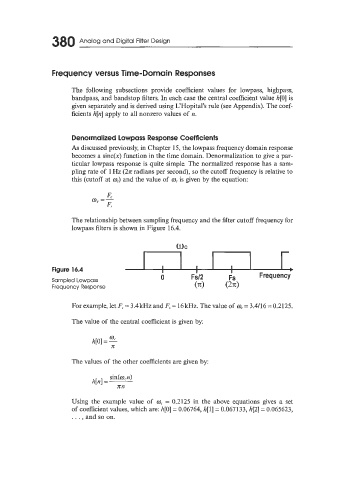
                       The relationship between sampling frequency and the filter cutoff frequency for
                       lowpass filters is shown in Figure 16.4.


                                                                                      -


                                                  I          I         1


                       For example, let 4. = 3.4kHz and Fs = 16 kHz. The value of a,= 3.4/16 = 0.2125.

                       The value of the central coefficient is given by:


                       The values of the other coefficients are given by:

                                  sin(w,n)
                             k[n] =  ~
                                     zn

                       Using  the  example value  of  w,. = 0.2125 in  the  above equations gives  a  set
                       of coefficient values, which are: h[O] = 0.06764, h[l] = O.O67133,h[2] = 0.065623,
                       . . . , and so on.

