


Page 376 - Applied Process Design For Chemical And Petrochemical Plants Volume III
P. 376
66131_Ludwig_CH11A  5/30/2001 4:50 PM  Page 333


                                                                Refrigeration Systems                                      333

                                                                           the evaporator has changed, and the composition of the
                                                                           vapor in equilibrium with it is not known. Vapor and liquid
                                                                           compositions in the condenser are also not known, but
                                                                           three important facts can be established:
                                                                             1. By material balance, the composition of the vapor
                                                                               entering the condenser is the same composition as the
                                                                               liquid leaving the condenser (with no bleed off).
                                                                             2. The condensed liquid at the top of the condenser is in
                                                                               equilibrium with the vapor composition entering the
                                                                               condenser, which is also the composition of the vapor
                                                                               leaving the evaporator.
                                                                             3. The mixture (liquid and vapor) in the total system must
                                                                               have the same overall composition as the initial charge.
                                                                             The problem is one of trial and error and illustrates the
                                                                           procedure.

                                                                           Liquid and Vapor Equilibrium
                                                                             See Chapter 12 for Mollier Diagrams.

                                                                           Given

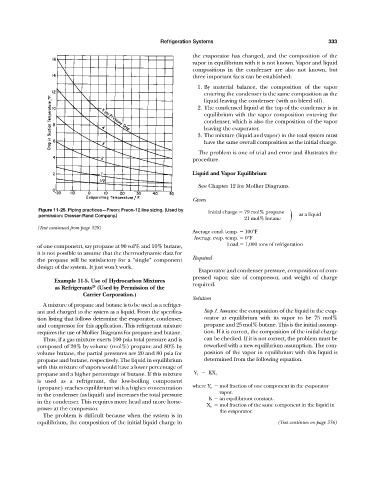
                      Figure 11-25. Piping practices—Freon; Freon-12 line sizing. (Used by  Initial charge   79 mol% propane
                      permission: Dresser-Rand Company.)                                     21 mol% butane     as a liquid
                     (Text continued from page 328)
                                                                           Average cond. temp.   100°F
                                                                            Average evap. temp.   0°F
                     of one component, say propane at 90 vol% and 10% butane,          Load   1,000 tons of refrigeration
                     it is not possible to assume that the thermodynamic data for
                                                                           Required
                     the propane will be satisfactory for a “single” component
                     design of the system. It just won’t work.
                                                                             Evaporator and condenser pressure, composition of com-
                                                                           pressed vapor, size of compressor, and weight of charge
                           Example 11-5. Use of Hydrocarbon Mixtures
                                                                           required.
                                        29
                            as Refrigerants (Used by Permission of the
                                     Carrier Corporation.)
                                                                           Solution
                       A mixture of propane and butane is to be used as a refriger-
                     ant and charged to the system as a liquid. From the specifica-  Step 1. Assume the composition of the liquid in the evap-
                     tion listing that follows determine the evaporator, condenser,  orator at equilibrium with its vapor to be 75 mol%
                     and compressor for this application. This refrigerant mixture  propane and 25 mol% butane. This is the initial assump-
                     requires the use of Mollier Diagrams for propane and butane.  tion. If it is correct, the composition of the initial charge
                       Thus, if a gas mixture exerts 100 psia total pressure and is  can be checked. If it is not correct, the problem must be
                     composed of 20% by volume (mol%) propane and 80% by       reworked with a new equilibrium assumption. The com-
                     volume butane, the partial pressures are 20 and 80 psia for  position of the vapor in equilibrium with this liquid is
                     propane and butane, respectively. The liquid in equilibrium  determined from the following equation.
                     with this mixture of vapors would have a lower percentage of
                     propane and a higher percentage of butane. If this mixture  Y e      KX e
                     is used as a refrigerant, the low-boiling component
                     (propane) reaches equilibrium with a higher concentration  where Y e   mol fraction of one component in the evaporator
                                                                                     vapor.
                     in the condenser (as liquid) and increases the total pressure
                                                                                 K   an equilibrium constant.
                     in the condenser. This requires more head and more horse-
                                                                                X e   mol fraction of the same component in the liquid in
                     power at the compressor.
                                                                                     the evaporator.
                       The problem is difficult because when the system is in
                     equilibrium, the composition of the initial liquid charge in                        (Text continues on page 336)

