


Page 411 - Applied Process Design For Chemical And Petrochemical Plants Volume III
P. 411
66131_Ludwig_CH12A  6/1/01 11:00 AM  Page 368


                                                                                                 Chapter


                                                                                                     12


                                     Compression Equipment


                                                 (Including Fans)


                    Compression of gases and vapors is an important opera-  Determining and specifying the required process perfor-
                  tion in chemical and petrochemical plants. It is necessary to  mance and mechanical requirements, including the corro-
                  be able to specify the proper type of equipment by its char-  sive and hazardous nature and the moisture content of the
                  acteristic performance. The compression step is conve-  fluids (gases/vapors) to be compressed, is important.
                  niently identified for the process design engineer by the
                  principal operation of the equipment:                               General Application Guide
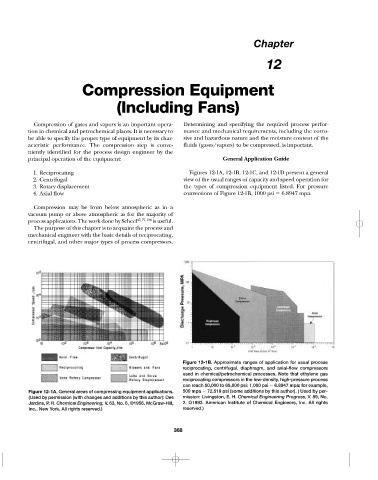
                    1. Reciprocating                                      Figures 12-1A, 12-1B, 12-1C, and 12-1D present a general
                    2. Centrifugal                                      view of the usual ranges of capacity and speed operation for
                    3. Rotary displacement                              the types of compression equipment listed. For pressure
                    4. Axial flow                                       conversions of Figure 12-1B, 1000 psi   6.8947 mpa.

                    Compression may be from below atmospheric as in a
                  vacuum pump or above atmospheric as for the majority of
                  process applications. The work done by Scheel 47, 77, 138  is useful.
                    The purpose of this chapter is to acquaint the process and
                  mechanical engineer with the basic details of reciprocating,
                  centrifugal, and other major types of process compressors.


                                                                        Figure 12-1B. Approximate ranges of application for usual process
                                                                        reciprocating, centrifugal, diaphragm, and axial-flow compressors
                                                                        used in chemical/petrochemical processes. Note that ethylene gas
                                                                        reciprocating compressors in the low-density, high-pressure process
                                                                        can reach 50,000 to 65,000 psi; 1,000 psi   6.8947 mpa; for example,
                  Figure 12-1A. General areas of compressing equipment applications.  500 mpa   72,519 psi (some additions by this author). ( Used by per-
                  (Used by permission (with changes and additions by this author): Des  mission: Livingston, E. H. Chemical Engineering Progress, V. 89, No.
                  Jardins, P. R. Chemical Engineering, V. 63, No. 6, ©1956. McGraw-Hill,  2, ©1993. American Institute of Chemical Engineers, Inc. All rights
                  Inc., New York. All rights reserved.)                 reserved.)


                                                                     368

