


Page 407 - Applied Process Design For Chemical And Petrochemical Plants Volume III
P. 407
66131_Ludwig_CH11A  5/30/2001 4:51 PM  Page 364


                       364                       Applied Process Design for Chemical and Petrochemical Plants

                                           Table 11-14
                          Theoretical Compressor Power for a Refrigerant-12
                           Plant Requiring 10 Tons at 44°F, 30 Tons at 34°F,
                                        and 20 Tons at 24°F
                                                              % Reduction
                       Type of System                     Hp   from Max.
                       One Compressor:
                         All evaporators at same temp. (24°F)  52.7  0
                           **Individual exp. valves and
                             back-pressure valves         52.7     0
                           Multiple exp. valves and
                             back-pressure valves         52.7     0
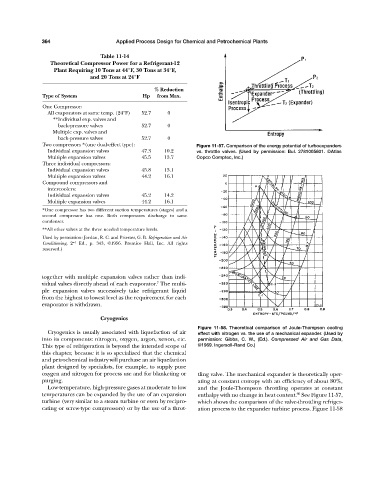
                       Two compressors *(one dual-effect type):              Figure 11-57. Comparison of the energy potential of turboexpanders
                         Individual expansion valves      47.3    10.2       vs. throttle valves. (Used by permission: Bul. 2781005601. ©Atlas
                         Multiple expansion valves        45.5    13.7       Copco Comptec, Inc.)
                       Three individual compressors:
                         Individual expansion valves      45.8    13.1
                         Multiple expansion valves        44.2    16.1
                       Compound compressors and
                         intercoolers:
                         Individual expansion valves      45.2    14.2
                         Multiple expansion valves        44.2    16.1
                       *One compressor has two different suction temperatures (stages) and a
                       second compressor has one. Both compressors discharge to same
                       condenser.
                       **All other valves at the three needed temperature levels.
                       Used by permission: Jordan, R. C. and Priester, G. B. Refrigeration and Air
                       Conditioning, 2 nd  Ed., p. 343, ©1956. Prentice Hall, Inc. All rights
                       reserved.)


                       together with multiple expansion valves rather than indi-
                                                               7
                       vidual valves directly ahead of each evaporator. The multi-
                       ple expansion valves successively take refrigerant liquid
                       from the highest to lowest level as the requirement for each
                       evaporator is withdrawn.

                                           Cryogenics
                                                                             Figure 11-58.  Theoretical comparison of Joule-Thompson cooling
                         Cryogenics is usually associated with liquefaction of air  effect with nitrogen vs. the use of a mechanical expander. (Used by
                       into its components: nitrogen, oxygen, argon, xenon, etc.  permission: Gibbs, C. W., (Ed.).  Compressed Air and Gas Data,
                       This type of refrigeration is beyond the intended scope of  ©1969. Ingersoll-Rand Co.)
                       this chapter, because it is so specialized that the chemical
                       and petrochemical industry will purchase an air liquefaction
                       plant designed by specialists, for example, to supply pure
                       oxygen and nitrogen for process use and for blanketing or  tling valve. The mechanical expander is theoretically oper-
                       purging.                                              ating at constant entropy with an efficiency of about 80%,
                         Low-temperature, high-pressure gases at moderate to low  and the Joule-Thompson throttling operates at constant
                                                                                                                60
                       temperatures can be expanded by the use of an expansion  enthalpy with no change in heat content. See Figure 11-57,
                       turbine (very similar to a steam turbine or even by recipro-  which shows the comparison of the valve-throttling refriger-
                       cating or screw-type compressors) or by the use of a throt-  ation process to the expander turbine process. Figure 11-58

