


Page 404 - Applied Process Design For Chemical And Petrochemical Plants Volume III
P. 404
66131_Ludwig_CH11A  5/30/2001 4:50 PM  Page 361


                                                                Refrigeration Systems                                      361


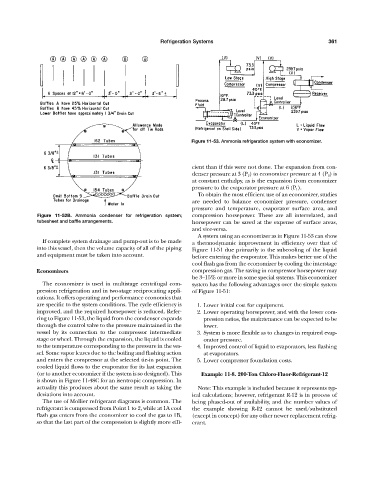
                                                                           Figure 11-53. Ammonia refrigeration system with economizer.


                                                                           cient than if this were not done. The expansion from con-
                                                                           denser pressure at 3 (P 2 ) to economizer pressure at 4 (P 3 ) is
                                                                           at constant enthalpy, as is the expansion from economizer
                                                                           pressure to the evaporator pressure at 6 (P 1 ).
                                                                             To obtain the most efficient use of an economizer, studies
                                                                           are needed to balance economizer pressure, condenser
                                                                           pressure and temperature, evaporator surface area, and
                     Figure 11-52B.  Ammonia condenser for refrigeration system;  compression horsepower. These are all interrelated, and
                     tubesheet and baffle arrangements.                    horsepower can be saved at the expense of surface areas,
                                                                           and vice-versa.
                                                                             A system using an economizer as in Figure 11-53 can show
                       If complete system drainage and pump-out is to be made  a thermodynamic improvement in efficiency over that of
                     into this vessel, then the volume capacity of all of the piping  Figure 11-51 due primarily to the subcooling of the liquid
                     and equipment must be taken into account.             before entering the evaporator. This makes better use of the
                                                                           cool flash gas from the economizer by cooling the interstage
                     Economizers                                           compression gas. The saving in compressor horsepower may
                                                                           be 3—15% or more in some special systems. This economizer
                       The economizer is used in multistage centrifugal com-  system has the following advantages over the simple system
                     pression refrigeration and in two-stage reciprocating appli-  of Figure 11-51:
                     cations. It offers operating and performance economics that
                     are specific to the system conditions. The cycle efficiency is  1. Lower initial cost for equipment.
                     improved, and the required horsepower is reduced. Refer-  2. Lower operating horsepower, and with the lower com-
                     ring to Figure 11-53, the liquid from the condenser expands  pression ratios, the maintenance can be expected to be
                     through the control valve to the pressure maintained in the  lower.
                     vessel by its connection to the compressor intermediate  3. System is more flexible as to changes in required evap-
                     stage or wheel. Through the expansion, the liquid is cooled  orator pressure.
                     to the temperature corresponding to the pressure in the ves-  4. Improved control of liquid to evaporators, less flashing
                     sel. Some vapor leaves due to the boiling and flashing action  at evaporators.
                     and enters the compressor at the selected tie-in point. The  5. Lower compressor foundation costs.
                     cooled liquid flows to the evaporator for its last expansion
                     (or to another economizer if the system is so designed). This  Example 11-8. 200-Ton Chloro-Fluor-Refrigerant-12
                     is shown in Figure 11-48C for an isentropic compression. In
                     actuality this produces about the same result as taking the  Note: This example is included because it represents typ-
                     deviations into account.                              ical calculations; however, refrigerant R-12 is in process of
                       The use of Mollier refrigerant diagrams is common. The  being phased-out of availability, and the number values of
                     refrigerant is compressed from Point 1 to 2, while at 1A cool  the example showing R-12 cannot be used/substituted
                     flash gas enters from the economizer to cool the gas to 1B,  (except in concept) for any other newer replacement refrig-
                     so that the last part of the compression is slightly more effi-  erant.

