


Page 190 - Basics of MATLAB and Beyond
P. 190
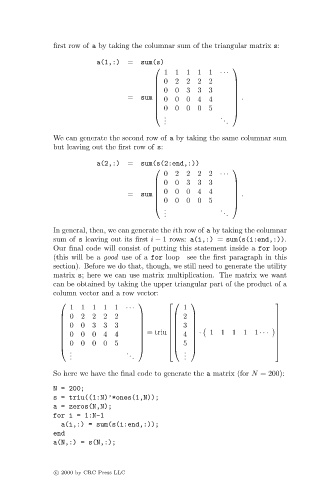
first row of a by taking the columnar sum of the triangular matrix s:
a(1,:) = sum(s)
11111 ···
02222
00333
00044 .
= sum
00005
. .
. .
. .
We can generate the second row of a by taking the same columnar sum
but leaving out the first row of s:
a(2,:) = sum(s(2:end,:))
02222 ···
00333
00044
= sum .
00005
. .
. .
. .
In general, then, we can generate the ith row of a by taking the columnar
sum of s leaving out its first i − 1 rows: a(i,:) = sum(s(i:end,:)).
Our final code will consist of putting this statement inside a for loop
(this will be a good use of a for loop—see the first paragraph in this
section). Before we do that, though, we still need to generate the utility
matrix s; here we can use matrix multiplication. The matrix we want
can be obtained by taking the upper triangular part of the product of a
column vector and a row vector:
11111 ··· 1
02222 2
00333 3
00044 4 ·
= triu 11111 ···
00005 5
. . . . . . . . .
So here we have the final code to generate the a matrix (for N = 200):
N = 200;
s = triu((1:N)’*ones(1,N));
a = zeros(N,N);
for i = 1:N-1
a(i,:) = sum(s(i:end,:));
end
a(N,:) = s(N,:);
c 2000 by CRC Press LLC

