Page 189 - Basics of MATLAB and Beyond
P. 189
do very fast operations on the appropriate matrices. matlab’s suite of
                               utility matrices can also come in handy when vectorising code (see help
                               elmat).
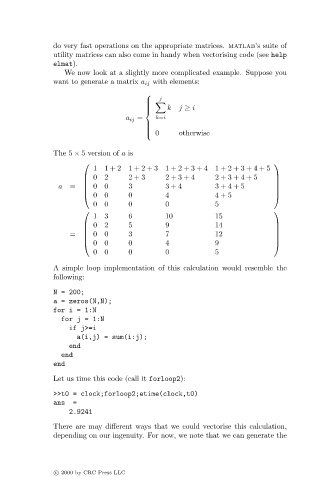
                                  We now look at a slightly more complicated example. Suppose you
                               want to generate a matrix a ij with elements:
                                                       
                                                           j
                                                       
                                                       
                                                             k   j ≥ i
                                                       
                                                       
                                                       
                                                  a ij =  k=i
                                                       
                                                       
                                                       
                                                       
                                                         0      otherwise
                               The 5 × 5 version of a is
                                                                                         
                                          1  1+2   1+2+3     1+2+3+4      1+2+3+4+5
                                          0  2     2+3       2+3+4        2+3+4+5
                                                                                         
                                                                                         
                                a =      0  0     3         3 +4         3+4+5           
                                                                                         
                                        0   0     0         4            4+5             
                                          00       0         0            5
                                                                                         
                                          13       6         10           15
                                          02       5         9            14
                                                                                         
                                                                                         
                                   =     00       3         7            12              
                                                                                         
                                        00        0         4            9               
                                          00       0         0            5
                               A simple loop implementation of this calculation would resemble the
                               following:
                               N = 200;
                               a = zeros(N,N);
                               for i = 1:N
                                 for j = 1:N
                                   if j>=i
                                     a(i,j) = sum(i:j);
                                   end
                                 end
                               end
                               Let us time this code (call it forloop2):

                               >>t0 = clock;forloop2;etime(clock,t0)
                               ans  =
                                   2.9241
                               There are may different ways that we could vectorise this calculation,
                               depending on our ingenuity. For now, we note that we can generate the


                               c   2000 by CRC Press LLC
   184   185   186   187   188   189   190   191   192   193   194