


Page 334 - Battery Reference Book
P. 334
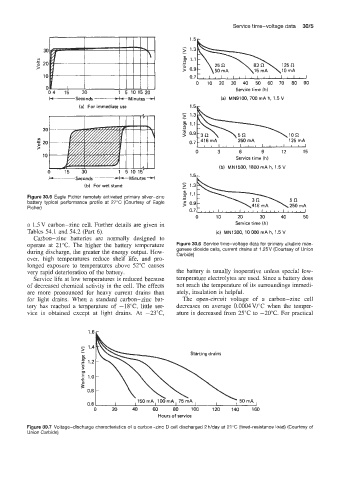
Service time-voltage  data  3015

                                                         1.5r
              30
                                                       p  1.1
              20
                                                       9  0.9    50 mA
              10
                                                           0   10   20   30   40   50   60  70   80  90
               0                                                       Service time lh)
               04   15   30         1  5  10  15  20
                -Seconds     -Minutes       4                      (a)  MN91M). 700 mA h,  1.5 V
                         (a)  For immediate use          1.5r


                                                           0      3     6      9     12    15
                                                                       Service time (h)
                                                                  (b)  MN1500, 1800 mA h,  1.5 V
                                                         1.5,
               -Seconds      -Minutes        4
                          (b)  For wet stand
         Figure 30.5  Eagle Picher remotely activated primary silver-zinc
         battery typical performance profile at  27°C  (Courtesy of  Eagle   ; 0.Y
                                                                                       250
         Picher)                                                        \416   mA  \ mA
                                                         0.7   a   c   8  t   2   3   I   8   *   a  I   a   0   t   8  I   5   a   9   1  J
                                                           0     10     20    30    40     50
         a  1.5V carbon-zinc  cell. Further details are given in       Service time (hi
         Tables 54.1 and 54.2 (Part 6).                          (c)  MN1300, 10 Ow mA h,  1.5 V
           Carbon-zinc  batteries  are  normally  designed  to
         operate  at  21°C. The  higher  the  battery  temperature   Figure 30.6 Service time-voltage  data for primary alkaline man-
         during discharge, the greater the energy output. How-   ganese dioxide cells, current drains at 1.25V (Courtesy of  Union
                                                     Carbide)
         ever,  high  temperatures  reduce  shelf  life,  and  pro-
         longed  exposure  to  temperatures  above  52°C  causes
         very rapid deterioration of the battery.    the  battery is usually  inoperative unless  special low-
           Service life at low temperatures is reduced because   temperature electrolytes are used. Since a battery does
         of  decreased chemical activity in the cell. The effects   not reach the temperature of its surroundings immedi-
         are  more  pronounced  for  heavy  current  drains  than   ately, insulation is helpful.
         for  light  drains.  When  a  standard  carbon-zinc  bat-   The  open-circuit  voltage  of  a  carbon-zinc  cell
         tery  has  reached  a  temperature  of  -18"C,  little  ser-   decreases  on  average  O.O004V/"C when  the  temper-
         vice  is  obtained  except  at  light  drains.  At  -23"C,   ature is decreased from 25°C to -20°C.  For practical


                         -
                         5:  1.4
                         m
                         0)                               Starting drains
                         - 2 1.2
                         9
                         m
                         5  1.0
                         P
                           0.8
                           0.6
                             0    20    40    60    80    100   120   140   160
                                                Hours of service
         Figure 30.7 Voltage-discharge  characteristics of a carbon-zinc  0 cell discharged 2 h/day at 21 "C (fixed-resistance load) (Courtesy of
         Union Carbide)

