


Page 372 - Between One and Many The Art and Science of Public Speaking
P. 372
(Transition: So what causes skin cancer?)

                       II.   Much as we may like the sun, too much of this good
                        thing is bad for us.
                        A.   The sun’s rays contain ultraviolet radiation.
                        B.  Science has linked ultraviolet radiation from the
                          sun with basal cell and squamous cell skin cancer
                          (Kalb, 2001).
                          1.  Scientists at the National Cancer Institute also
                            believe that ultraviolet radiation is linked to mela-
                            noma, although the relationship is not as clear
                            (Kalb, 2001).
                          2.  Melanoma can show up anywhere on the skin
                            and can develop in even dark-skinned people.
                          3.  For example, did you know that Bob Marley died
                            from melanoma skin cancer?
                        C.  As few as three severe sunburns in childhood put
                          you at increased risk for skin cancer.

                    (Transition: Even though the incidence of skin cancer is
                    increasing, you have considerable control over this risk.)
                     III.  The American Cancer Society and the American Der-
                        matological Association have developed some simple
                        guidelines to follow: (American Cancer Society, 1996)
                        A.  Avoid the sun between 10 B/N/ and 4 Q/N/ when
                          possible.
                        B.  Always wear a sunscreen with sun protection factor
                          of 15 or better, and wear sun-protective clothing
                          such as a wide-brimmed hat, long-sleeved shirt,
                          and long pants.
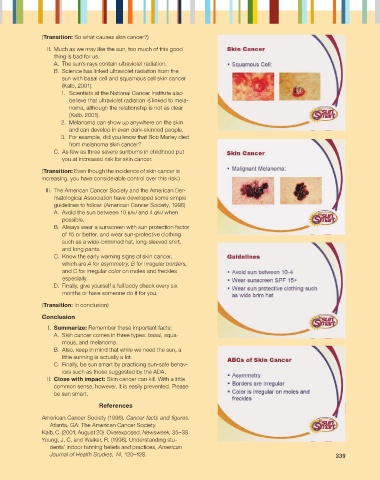
                        C.  Know the early warning signs of skin cancer,
                          which are A for asymmetry, B for irregular borders,
                          and C for irregular color on moles and freckles
                          especially.
                        D.  Finally, give yourself a full body check every six
                          months or have someone do it for you.

                    (Transition: In conclusion)
                    Conclusion
                       I.   Summarize: Remember these important facts:
                        A.  Skin cancer comes in three types: basal, squa-
                          mous, and melanoma.
                        B.  Also, keep in mind that while we need the sun, a
                          little sunning is actually a lot.
                        C.  Finally, be sun smart by practicing sun-safe behav-
                          iors such as those suggested by the ADA.
                       II.   Close with impact: Skin cancer can kill. With a little
                        common sense, however, it is easily prevented. Please
                        be sun smart.

                                     References
                    American Cancer Society (1996). Cancer facts and fi gures.
                       Atlanta, GA: The American Cancer Society.
                    Kalb, C. (2001, August 20). Overexposed. Newsweek, 35–38.
                    Young, J. C. and Walker, R. (1998). Understanding stu-
                       dents’ indoor tanning beliefs and practices, American
                       Journal of Health Studies, 14, 120–128.                                              339

