


Page 483 - Cam Design Handbook
P. 483
THB14  9/19/03  7:58 PM  Page 471

                                   SPECIAL CAM MECHANISMS                  471

                                   F =  F tana  = 2 T Dtana              (14.17)
                                    c   t
            where  T = the  torque  transmitted  in-lb  and  D = the  effective  diameter  of  the  rollers,
            inches.


            14.14 TWO INDEPENDENT CAMS
            IN SERIES (AUTOMOTIVE)

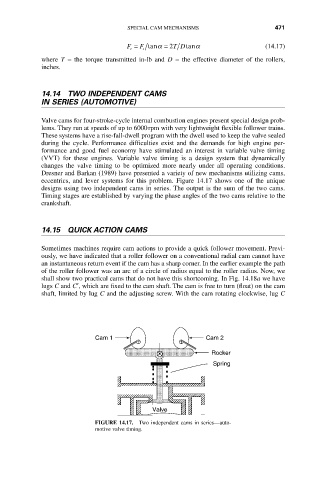
            Valve cams for four-stroke-cycle internal combustion engines present special design prob-
            lems. They run at speeds of up to 6000rpm with very lightweight flexible follower trains.
            These systems have a rise-fall-dwell program with the dwell used to keep the valve sealed
            during  the  cycle.  Performance  difficulties  exist  and  the  demands  for  high  engine  per-
            formance  and  good  fuel  economy  have  stimulated  an  interest  in  variable  valve  timing
            (VVT)  for  these  engines.  Variable  valve  timing  is  a  design  system  that  dynamically
            changes  the  valve  timing  to  be  optimized  more  nearly  under  all  operating  conditions.
            Dresner and Barkan (1989) have presented a variety of new mechanisms utilizing cams,
            eccentrics,  and  lever  systems  for  this  problem.  Figure  14.17  shows  one  of  the  unique
            designs using two independent cams in series. The output is the sum of the two cams.
            Timing stages are established by varying the phase angles of the two cams relative to the
            crankshaft.


            14.15 QUICK ACTION CAMS


            Sometimes machines require cam actions to provide a quick follower movement. Previ-
            ously, we have indicated that a roller follower on a conventional radial cam cannot have
            an instantaneous return event if the cam has a sharp corner. In the earlier example the path
            of the roller follower was an arc of a circle of radius equal to the roller radius. Now, we
            shall show two practical cams that do not have this shortcoming. In Fig. 14.18a we have
            lugs C and C¢, which are fixed to the cam shaft. The cam is free to turn (float) on the cam
            shaft, limited by lug C and the adjusting screw. With the cam rotating clockwise, lug C


                           Cam 1                         Cam 2
                                                          Rocker
                                                           Spring


                                          Valve
                           FIGURE 14.17. Two independent cams in series—auto-
                           motive valve timing.

