


Page 486 - Cam Design Handbook
P. 486
THB14  9/19/03  7:58 PM  Page 474

          474                      CAM DESIGN HANDBOOK

          indexing directions without backtracking. This mechanism has been applied to index the
          stays on a stamping machine. A stationary pin (not shown) is in position 1 with the cam
          hammer assembly fully retracted. At position 2, the hammer has completed its stamping
          blow. As the hammer assembly retracks, the cam track follows the stationary pin to posi-
          tion 3 to impart rotary motion to the inverse cam.


          14.18 CAM TO CONVERT ROTARY
          TO LINEAR MOTION

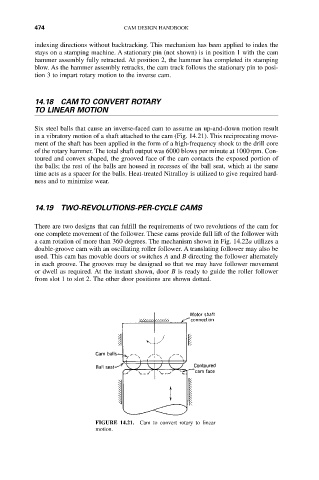
          Six steel balls that cause an inverse-faced cam to assume an up-and-down motion result
          in a vibratory motion of a shaft attached to the cam (Fig. 14.21). This reciprocating move-
          ment of the shaft has been applied in the form of a high-frequency shock to the drill core
          of the rotary hammer. The total shaft output was 6000 blows per minute at 1000rpm. Con-
          toured and convex shaped, the grooved face of the cam contacts the exposed portion of
          the balls; the rest of the balls are housed in recesses of the ball seat, which at the same
          time acts as a spacer for the balls. Heat-treated Nitralloy is utilized to give required hard-
          ness and to minimize wear.


          14.19 TWO-REVOLUTIONS-PER-CYCLE CAMS

          There are two designs that can fulfill the requirements of two revolutions of the cam for
          one complete movement of the follower. These cams provide full lift of the follower with
          a cam rotation of more than 360 degrees. The mechanism shown in Fig. 14.22a utilizes a
          double-groove cam with an oscillating roller follower. A translating follower may also be
          used. This cam has movable doors or switches A and B directing the follower alternately
          in each groove. The grooves may be designed so that we may have follower movement
          or dwell as required. At the instant shown, door B is ready to guide the roller follower
          from slot 1 to slot 2. The other door positions are shown dotted.


                           FIGURE  14.21. Cam  to  convert  rotary  to  linear
                           motion.

