


Page 188 - Catalysts for Fine Chemical Synthesis Vol 1 - Robert & Poignant
P. 188
176 hydrolysis, oxidation and reduction
0
12.7.6 Preparation of [(COD) Rh(( p S, p S)-1,1 -bis(diphenylphosphino)-
0
2,2 -bis(1-ethylpropyl)ferrocene] BF . . . . . . . . . . . . 200
ÿ
4
12.7.7 Asymmetric hydrogenation of a-acetamido cinnamic acid . . . . . . 201
12.8 Synthesis and application of diamino FERRIPHOS as ligand for
enantioselective Rh-catalysed preparation of chiral a-amino acids
Matthias Lotz, Juan J. Almena Perea and Paul Knochel. . . . . . . 202
0
12.8.1 Synthesis of 1,1 -di(benzoyl)ferrocene . . . . . . . . . . . . 202
12.8.2 Synthesis of (S,S)-1,1 -bis(a-hydroxyphenylmethyl)ferrocene . . . . . 204
0
12.8.3 Synthesis of (S,S)-1,1 -bis(a-acetoxyphenylmethyl)ferrocene . . . . . 205
0
0
12.8.4 Synthesis of (S,S)-1,1 -bis(a-N,N-dimethylaminophenylmethyl) ferrocene . 206
0
0
12.8.5 Synthesis of (aS, a S) ÿ 1, 1 -bis(a-N,
N-dimethylaminophenylmethyl)-(R,R)-1,1 bis(diphenylphosphino)
0
ferrocene . . . . . . . . . . . . . . . . . . . . 207
12.8.6 Asymmetric hydrogenation of methyl-(Z)-3-phenyl-2-methyl-
carboxamido-2-propenoate using diamino Ferriphos as chiral ligand . . 209
References. . . . . . . . . . . . . . . . . . . . . . . 210
12.1 INTRODUCTION
Acrylic acid derivatives were chosen as substrates in the early studies on asym-
metric hydrogenation of olefins. The additional coordinating functionality such
as an amido, carboxyl, amidomethyl, carbalkoxymethyl or hydrocarbonyl-
methyl group is a prerequisite for getting higher enantioselectivities. Concerning
the synthesis of enantiomerically pure a-amino acids, chiral rhodium±dipho-
sphines [1±3] or ruthenium- [4] catalysts were found to give good results for the
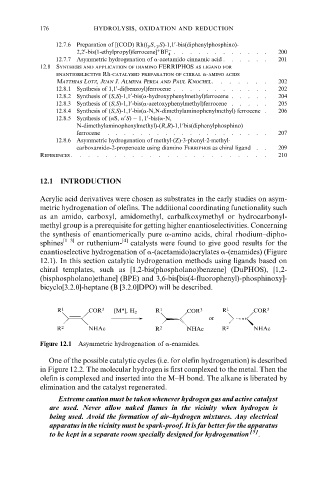
enantioselective hydrogenation of a-(acetamido)acrylates a-(enamides) (Figure
12.1). In this section catalytic hydrogenation methods using ligands based on
chiral templates, such as [1,2-bis(phospholano)benzene] (DuPHOS), [1,2-
(bisphospholano)ethane] (BPE) and 3,6-bis[bis(4-fluorophenyl)-phosphinoxy]-
bicyclo[3.2.0]-heptane (B [3.2.0]DPO) will be described.
R 1 COR 3 [M*], H 2 R 1 COR 3 R 1 COR 3
or
R 2 NHAc R 2 NHAc R 2 NHAc
Figure 12.1 Asymmetric hydrogenation of a-enamides.
One of the possible catalytic cycles (i.e. for olefin hydrogenation) is described
in Figure 12.2. The molecular hydrogen is first complexed to the metal. Then the
olefin is complexed and inserted into the M±H bond. The alkane is liberated by
elimination and the catalyst regenerated.
Extreme caution must be taken whenever hydrogen gas and active catalyst
are used. Never allow naked flames in the vicinity when hydrogen is
being used. Avoid the formation of air±hydrogen mixtures. Any electrical
apparatus in the vicinity must be spark-proof. It is far better for the apparatus
to be kept in a separate room specially designed for hydrogenation [5] .

