


Page 192 - Catalysts for Fine Chemical Synthesis Vol 1 - Robert & Poignant
P. 192
180 hydrolysis, oxidation and reduction
reaction was allowed to stir at 20 8C until no further hydrogen uptake was
observed (3 hours).
4. The reaction was followed by chiral GC (SE 30, 220 8C, nitrogen mobile
phase). R t (a-acetamido cinnamic acid): 3.70 min; R t (N-acetyl-l-phenyl-
alanine): 5.4 min.
5. The reaction was concentrated to give a yellow oil (300 mg) which was
crystallized with ethanol and petroleum ether to give slightly yellow crystals
(235 mg, 90 %).
The ee (>98 %) was determined by chiral HPLC (Chiralpak 1 AD,
Hexane-IPA-TFA, 89 %±10 %±1 %, sample dissolved in IPA) R t (R)-enan-
tiomer: 11.9 min, R t (S)-enantiomer: 14.3 min.
1 H NMR(200 MHz, DMSO): d8:25 (d, J 8.2 Hz, 1H, NH); 7.26 (m, 5H,
Ph); 4.42 (m, 1H, CH); 3.07 (dd, J 13.7 Hz, J 4.9 Hz, 1H, CH a H b ); 2.85 (dd,
J 13.7 Hz, J 9.9 Hz, 1H, CH a H b ); 1.75 (s, 3H, CO-CH 3 ).
Mass: calculated for C 11 H 13 O 4 N: m/z 207.08954; found [MH] 207.08975.
Conclusion
The procedures using [(COD) Rh (S, S)-Me-BPE] and [(COD) Rh (R,R)-Me-
DuPHOS] are very similar; they need a hydrogenation bomb and are conducted
under an inert atmosphere, as the catalysts are sensitive to oxygen. They give
good results (yield and enantiomeric excess) and hydrogenated products do not
need lengthy purification, since no secondary products were detected. The
reactions can be carried out under atmospheric pressure giving approximately
the same results but need a longer time to be complete. The reaction were
stopped when no more hydrogen was consumed; they were generally performed
overnight (14 hours). Table 12.1 gives some examples of b, b-disubstituted
enamides that can be hydrogenated by those catalysts in similar conditions.
12.4 HYDROGENATION OF AN a-AMIDOACRYLATE USING
[Rh(B[3.2.0]DPO)] COMPLEXES
ÿ
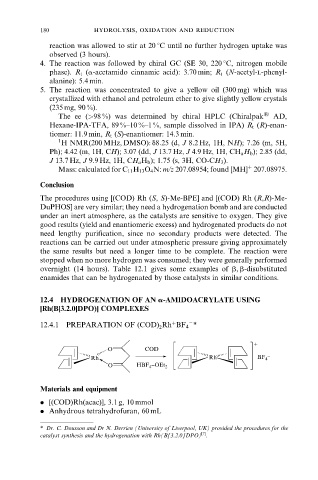
12.4.1 PREPARATION OF (COD) Rh BF 4 *
2
+
O COD
Rh Rh BF 4 −
O HBF 4 −OEt 2
Materials and equipment
. [(COD)Rh(acac)], 3.1 g, 10 mmol
. Anhydrous tetrahydrofuran, 60 mL
* Dr. C. Dousson and Dr N. Derrien (University of Liverpool, UK) provided the procedures for the
[7]
catalyst synthesis and the hydrogenation with Rh(B[3.2.0]DPO) .

