


Page 399 - Chemical Process Equipment - Selection and Design
P. 399
362  DISINTEGRATION, AGGLOMERATION.  AND  SIZE  SEPARATION OF PARTICULATE SOLIDS
                                                                   Materials  suitable  for  prilling  are  those  that  melt  without
                                                                decomposition, preferably have  a  low  heat  of  solidification and a
                                                                high  enough  melting  point  to  permit  the  use  of  ambient air  for
                                                                cooling. Because of  high  viscosities, spray wheels are preferred to
                                                                spray  nozzles.  The  wheels  often  are  equipped  with  scrapers  to
                                                                prevent clogging. Since several wheels are needed for capacity, they
                                                                are often arranged in line and the cross section of the tower is made
                                                                rectangular.
                                                                   The  density  of  the  prills is  reduced  substantially when  much
                                                                evaporation occurs: with  0.2-0.5%  water in the feed,  ammonium
                                                                nitrate prills have a specific gravity of  0.95, but with 3-5%  water it
                                                                falls to 0.75. Prilled granules usually are less dense than those made
                                                                by layering growth in drum or fluidized bed granulators. The latter
                                                                processes also can make larger prills economically. To make large
                                                                prills,  a  tall  tower  is  needed  to  ensure  solidification before  the
                                                                bottom is reached. The size distribution depends very much on the
                                                                character of  the atomization but can be made moderately uniform.
                                                                Some commercial data of  cumulative % less than size are:


                                                                       % Lessthansize   0   5   50   95   100
                                                                       Dia (rnrn)    1.2   1.6   2.4   3.5   4.8

                                                                    Cooling of  the prills can be accomplished more economically in
                                                                either  rotary  drums  of  fluidized  beds  than  in  additional  tower
                                                                height. Fluidized bed coolers are cheaper and better because more
                                                                easily dust controllable, and also because they can be incorporated
                                                                in  the  lower  section of  the  tower.  After  cooling, the  product  is
                                                                screened, and the fines are returned to the melter and recycled.


                                                                 FLUIDIZED AND SPOUTED BEDS

                                                                In fluidized bed  granulation,  liquid or solution is  sprayed onto or
                                                                into  the  bed,  and  growth  occurs by  agglomeration as  a  result of
                                                                binding of  small particles by the liquid or by  layering as a result of
                                                                evaporation  of  solution  on  the  surfaces  of  the  particles.  The
                                                                granules grown by layering are smoother and harder. Some attrition
                                                                also occurs and  tends  to widen  the  size distribution range  of  the
                                                                product.  Larger  agglomerates  are  obtained  when  the  ratio  of
                                              (C)               droplet/granule  diameters  decreases.  Increase  in  the  rate  of  the
                     -                     (e)                  are lifted off  the bottom and recirculated more thoroughly.
                                                                fluidizing  gas  and  in  the  temperature  of  the  bed  decreases
                                                                penetration  and  wetting  of  the  bed  and  hence  leads  to  smaller
                     SIDE  VIEW
                            CIRCULAR  CROSS- SECTIONS -
                                                                smaller proportion  of  the  particles  and  thus  leads  to  larger  size
                    flat face  bevel   SIDE  VIEW   SDE  VIEW   granule  sizes.  A  narrower  and  more  concentrated  spray wets  a
                                              deep  convex
                                                                product. The bed is often made conical so that the larger particles
                                standard  canvex
                       (d)
                     0                                             Initial  particle  size  distribution  often  is  in  the  range  of
                                      0  50-250  pm. The product of Table 12.19(a) is 0.7-2.4 mm dia.
                                                                   A  wide  range  of  operating  conditions is  used  commercially.
                                       TOP  VIEW
                     TOP  VIEW
                                                                Performance data are in Table 12.19. Gas velocities cover a range
                                                                of  3-20  times  the  minimum  fluidizing velocity or  0.1-2.5  m/sec.
                                                                Bed expansion ratios are up to 3 or so. As in fluidized bed drying,
                     SIDE  VIEW       SIDE  VIEW                bed depths are low, usually between 12 and 24 in. Evaporation rates
                       oblong          "foot ball"              are in the range 0.005-1.0  kg/(sec)(m2).
                                                                   Batch  fluidized  bed  granulation  is  practiced  for  small
                                    (C)
                                                                production rates or when the residence time must  be long. Figure
                                                                12.17(a)  and  Table  12.19(a)  are  of  an  arrangement  to  make
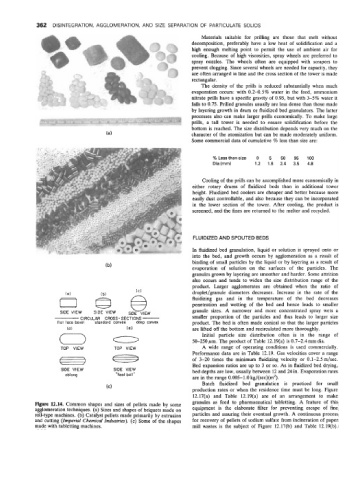
             Figure 12.14. Common shapes and sizes of  pellets made by  some   granules  as  feed  to  pharmaceutical  tabletting.  A  feature  of  this
             agglomeration techniques. (a) Sizes and shapes of  briquets made on   equipment  is  the  elaborate  filter  for  preventing  escape  of  fine
             roll-type machines. (b) Catalyst pellets made primarily by extrusion   particles and assuring their eventual growth. A continuous process
             and cutting (Imperial Chemical Zndustries). (c) Some of  the shapes   for recovery of  pellets of  sodium sulfate from incineration of  paper
             made with tabletting machines.                     mill  wastes is  the  subject of  Figure  12.17(b) and Table  12.19(b).

