


Page 247 - Compression Machinery for Oil and Gas
P. 247
Reciprocating Compressors Chapter  5 233


                     3
                                                           FEA
                          N = 6, D/d = 2.5
                                                           Griffith-Taylor
                          d = 8 in (203.2 mm)
                    2.5
                  Torsional stiffness ratio, K a /K b  (–)  1.5 2


                    0.5 1


                     0
                      0    0.05   0.1  0.15   0.2  0.25   0.3  0.35   0.4
                                            b/d (–)
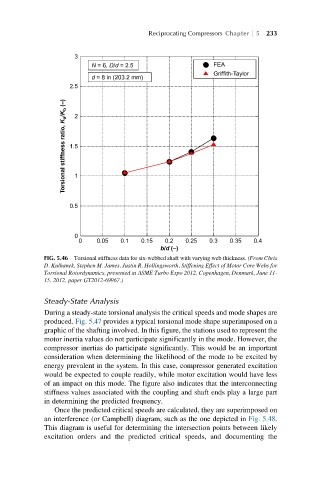
             FIG. 5.46 Torsional stiffness data for six-webbed shaft with varying web thickness. (From Chris
             D. Kulhanek, Stephen M. James, Justin R. Hollingsworth, Stiffening Effect of Motor Core Webs for
             Torsional Rotordynamics, presented at ASME Turbo Expo 2012, Copenhagen, Denmark, June 11-
             15, 2012, paper GT2012-69967.)

             Steady-State Analysis
             During a steady-state torsional analysis the critical speeds and mode shapes are
             produced. Fig. 5.47 provides a typical torsional mode shape superimposed on a
             graphic of the shafting involved. In this figure, the stations used to represent the
             motor inertia values do not participate significantly in the mode. However, the
             compressor inertias do participate significantly. This would be an important
             consideration when determining the likelihood of the mode to be excited by
             energy prevalent in the system. In this case, compressor generated excitation
             would be expected to couple readily, while motor excitation would have less
             of an impact on this mode. The figure also indicates that the interconnecting
             stiffness values associated with the coupling and shaft ends play a large part
             in determining the predicted frequency.
                Once the predicted critical speeds are calculated, they are superimposed on
             an interference (or Campbell) diagram, such as the one depicted in Fig. 5.48.
             This diagram is useful for determining the intersection points between likely
             excitation orders and the predicted critical speeds, and documenting the

