


Page 247 - Computational Modeling in Biomedical Engineering and Medical Physics
P. 247
236   Computational Modeling in Biomedical Engineering and Medical Physics


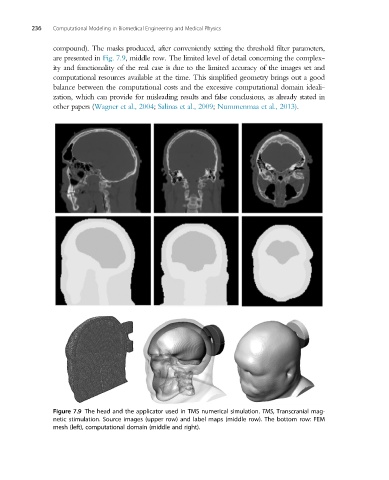
                compound). The masks produced, after conveniently setting the threshold filter parameters,
                are presented in Fig. 7.9, middle row. The limited level of detail concerning the complex-
                ity and functionality of the real case is due to the limited accuracy of the images set and
                computational resources available at the time. This simplified geometry brings out a good
                balance between the computational costs and the excessive computational domain ideali-
                zation, which can provide for misleading results and false conclusions, as already stated in
                other papers (Wagner et al., 2004; Salinas et al., 2009; Nummenmaa et al., 2013).


                Figure 7.9 The head and the applicator used in TMS numerical simulation. TMS, Transcranial mag-
                netic stimulation. Source images (upper row) and label maps (middle row). The bottom row: FEM
                mesh (left), computational domain (middle and right).

