


Page 135 -
P. 135
106  CHAPTER 3 / A TOP-LEVEL VIEW OF COMPUTER FUNCTION

                        you make, and explain. Hint: Determine the number of bytes that can be transferred
                        per bus cycle.
                    3.6  Consider a computer system that contains an I/O module controlling a simple key-
                        board/printer teletype. The following registers are contained in the processor and
                        connected directly to the system bus:
                           INPR:     Input Register, 8 bits
                           OUTR:     Output Register, 8 bits
                           FGI:      Input Flag, 1 bit
                           FGO:      Output Flag, 1 bit
                           IEN:      Interrupt Enable, 1 bit
                        Keystroke input from the teletype and printer output to the teletype are controlled
                        by the I/O module.The teletype is able to encode an alphanumeric symbol to an 8-bit
                        word and decode an 8-bit word into an alphanumeric symbol.
                        a. Describe how the processor, using the first four registers listed in this problem,
                           can achieve I/O with the teletype.
                        b. Describe how the function can be performed more efficiently by also employing IEN.
                    3.7  Consider two microprocessors having 8- and 16-bit-wide external data buses, re-
                        spectively. The two processors are identical otherwise and their bus cycles take just
                        as long.
                        a. Suppose all instructions and operands are two bytes long. By what factor do the
                           maximum data transfer rates differ?
                        b. Repeat assuming that half of the operands and instructions are one byte long.
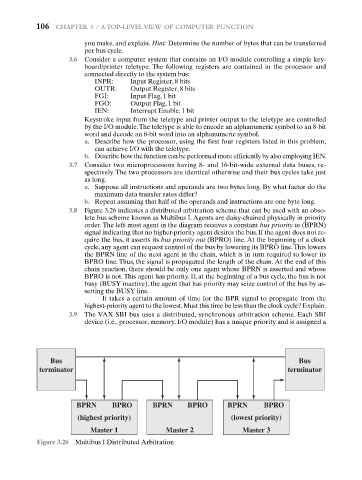
                    3.8  Figure 3.26 indicates a distributed arbitration scheme that can be used with an obso-
                        lete bus scheme known as Multibus I. Agents are daisy-chained physically in priority
                        order. The left-most agent in the diagram receives a constant bus priority in (BPRN)
                        signal indicating that no higher-priority agent desires the bus. If the agent does not re-
                        quire the bus, it asserts its bus priority out (BPRO) line. At the beginning of a clock
                        cycle, any agent can request control of the bus by lowering its BPRO line.This lowers
                        the BPRN line of the next agent in the chain, which is in turn required to lower its
                        BPRO line. Thus, the signal is propagated the length of the chain. At the end of this
                        chain reaction, there should be only one agent whose BPRN is asserted and whose
                        BPRO is not. This agent has priority. If, at the beginning of a bus cycle, the bus is not
                        busy (BUSY inactive), the agent that has priority may seize control of the bus by as-
                        serting the BUSY line.
                             It takes a certain amount of time for the BPR signal to propagate from the
                        highest-priority agent to the lowest.Must this time be less than the clock cycle? Explain.
                    3.9  The VAX SBI bus uses a distributed, synchronous arbitration scheme. Each SBI
                        device (i.e., processor, memory, I/O module) has a unique priority and is assigned a


               Bus                                                                 Bus
            terminator                                                          terminator


                      BPRN      BPRO       BPRN     BPRO       BPRN      BPRO
                      (highest priority)                        (lowest priority)
                          Master 1            Master 2             Master 3
           Figure 3.26 Multibus I Distributed Arbitration

