


Page 174 -
P. 174
144  CHAPTER 4 / CACHE MEMORY

           Table 4.6 ARM Cache Features

                                               Cache Line                         Write
                          Cache   Cache Size     Size                           Buffer Size
                Core      Type       (kB)       (words)   Associativity  Location  (words)
            ARM720T       Unified     8            4         4-way      Logical      8
            ARM920T        Split   16/16 D/I       8         64-way     Logical     16
            ARM926EJ-S     Split  4-128/4-128 D/I  8         4-way      Logical     16
            ARM1022E       Split   16/16 D/I       8         64-way     Logical     16
            ARM1026EJ-S    Split  4-128/4-128 D/I  8         4-way      Logical      8
            Intel
                           Split   16/16 D/I       4         32-way     Logical     32
            StrongARM
            Intel Xscale   Split   32/32 D/I       8         32-way     Logical     32
            ARM1136-JF-S   Split  4-64/4-64 D/I    8         4-way     Physical     32


                       Table 4.6 shows this evolution. The ARM7 models used a unified L1 cache,
                  while all subsequent models use a split instruction/data cache. All of the ARM de-
                  signs use a set-associative cache, with the degree of associativity and the line size
                  varying.ARM cached cores with an MMU use a logical cache for processor families
                  ARM7 through ARM10, including the Intel StongARM and Intel Xscale proces-
                  sors. The ARM11 family uses a physical cache. The distinction between logical and
                  physical cache is discussed earlier in this chapter (Figure 4.7).
                       An interesting feature of the ARM architecture is the use of a small first-in-
                  first out (FIFO) write buffer to enhance memory write performance. The write
                  buffer is interposed between the cache and main memory and consists of a set of ad-
                  dresses and a set of data words.The write buffer is small compared to the cache, and
                  may hold up to four independent addresses.Typically, the write buffer is enabled for
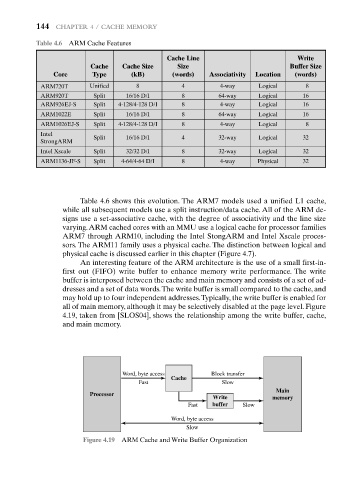
                  all of main memory, although it may be selectively disabled at the page level. Figure
                  4.19, taken from [SLOS04], shows the relationship among the write buffer, cache,
                  and main memory.


                                  Word, byte access        Block transfer
                                                Cache
                                       Fast                   Slow
                                                                            Main
                          Processor
                                                           Write           memory
                                                    Fast   buffer  Slow
                                                Word, byte access
                                                    Slow
                        Figure 4.19 ARM Cache and Write Buffer Organization

