


Page 221 -
P. 221
6.1 / MAGNETIC DISK 189


            Index

                         Physical sector 0    Physical sector 1          Physical sector 29
           Sector

                         ID      Data         ID      Data                ID      Data
                    Gap     Gap      Gap  Gap     Gap     Gap        Gap      Gap      Gap
                     1  field  2  field  3  1  field  2  field  3     1   field  2  field  3
                         0        0           1        1                  29       29
               Bytes  17  7  41  515  20  17  7   41  515  20         17   7  41  515  20
                                                                           600 bytes/sector

               Synch Track Head Sector  CRC      Synch
                byte  #  #   #                    byte  Data CRC
            Bytes  1  2  1   1    2                1  512  2
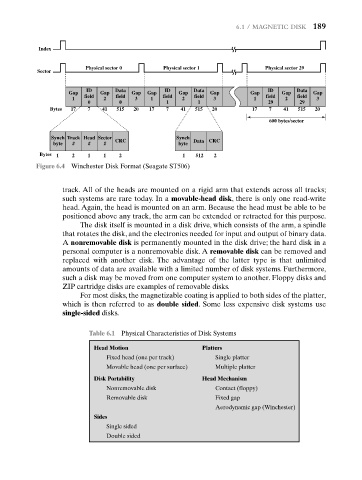
           Figure 6.4 Winchester Disk Format (Seagate ST506)


                  track. All of the heads are mounted on a rigid arm that extends across all tracks;
                  such systems are rare today. In a movable-head disk, there is only one read-write
                  head. Again, the head is mounted on an arm. Because the head must be able to be
                  positioned above any track, the arm can be extended or retracted for this purpose.
                       The disk itself is mounted in a disk drive, which consists of the arm, a spindle
                  that rotates the disk, and the electronics needed for input and output of binary data.
                  A nonremovable disk is permanently mounted in the disk drive; the hard disk in a
                  personal computer is a nonremovable disk. A removable disk can be removed and
                  replaced with another disk. The advantage of the latter type is that unlimited
                  amounts of data are available with a limited number of disk systems. Furthermore,
                  such a disk may be moved from one computer system to another. Floppy disks and
                  ZIP cartridge disks are examples of removable disks.
                       For most disks, the magnetizable coating is applied to both sides of the platter,
                  which is then referred to as double sided. Some less expensive disk systems use
                  single-sided disks.

                         Table 6.1 Physical Characteristics of Disk Systems

                           Head Motion                  Platters
                              Fixed head (one per track)    Single platter
                              Movable head (one per surface)  Multiple platter
                           Disk Portability             Head Mechanism
                              Nonremovable disk             Contact (floppy)
                              Removable disk                Fixed gap
                                                            Aerodynamic gap (Winchester)
                           Sides
                              Single sided
                              Double sided

