


Page 224 -
P. 224
192  CHAPTER 6 / EXTERNAL MEMORY

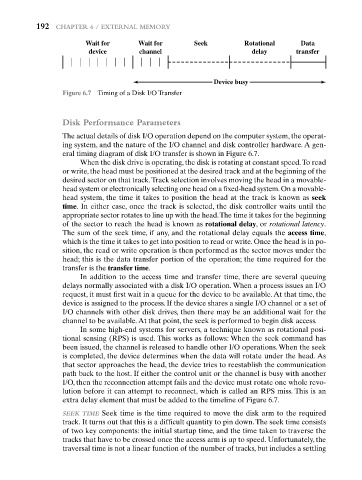
                        Wait for       Wait for       Seek          Rotational     Data
                         device        channel                        delay       transfer


                                                           Device busy
                  Figure 6.7 Timing of a Disk I/O Transfer


                  Disk Performance Parameters

                  The actual details of disk I/O operation depend on the computer system, the operat-
                  ing system, and the nature of the I/O channel and disk controller hardware. A gen-
                  eral timing diagram of disk I/O transfer is shown in Figure 6.7.
                       When the disk drive is operating, the disk is rotating at constant speed.To read
                  or write, the head must be positioned at the desired track and at the beginning of the
                  desired sector on that track.Track selection involves moving the head in a movable-
                  head system or electronically selecting one head on a fixed-head system.On a movable-
                  head system, the time it takes to position the head at the track is known as seek
                  time. In either case, once the track is selected, the disk controller waits until the
                  appropriate sector rotates to line up with the head.The time it takes for the beginning
                  of the sector to reach the head is known as rotational delay, or rotational latency.
                  The sum of the seek time, if any, and the rotational delay equals the access time,
                  which is the time it takes to get into position to read or write. Once the head is in po-
                  sition, the read or write operation is then performed as the sector moves under the
                  head; this is the data transfer portion of the operation; the time required for the
                  transfer is the transfer time.
                       In addition to the access time and transfer time, there are several queuing
                  delays normally associated with a disk I/O operation. When a process issues an I/O
                  request, it must first wait in a queue for the device to be available. At that time, the
                  device is assigned to the process. If the device shares a single I/O channel or a set of
                  I/O channels with other disk drives, then there may be an additional wait for the
                  channel to be available.At that point, the seek is performed to begin disk access.
                       In some high-end systems for servers, a technique known as rotational posi-
                  tional sensing (RPS) is used. This works as follows: When the seek command has
                  been issued, the channel is released to handle other I/O operations. When the seek
                  is completed, the device determines when the data will rotate under the head. As
                  that sector approaches the head, the device tries to reestablish the communication
                  path back to the host. If either the control unit or the channel is busy with another
                  I/O, then the reconnection attempt fails and the device must rotate one whole revo-
                  lution before it can attempt to reconnect, which is called an RPS miss. This is an
                  extra delay element that must be added to the timeline of Figure 6.7.
                  SEEK TIME Seek time is the time required to move the disk arm to the required
                  track. It turns out that this is a difficult quantity to pin down.The seek time consists
                  of two key components: the initial startup time, and the time taken to traverse the
                  tracks that have to be crossed once the access arm is up to speed. Unfortunately, the
                  traversal time is not a linear function of the number of tracks, but includes a settling

