


Page 223 -
P. 223
6.1 / MAGNETIC DISK 191

                  platter, allowing an air gap. At the other extreme is a head mechanism that actually
                  comes into physical contact with the medium during a read or write operation. This
                  mechanism is used with the floppy disk, which is a small, flexible platter and the
                  least expensive type of disk.
                       To understand the third type of disk, we need to comment on the relationship
                  between data density and the size of the air gap. The head must generate or sense
                  an electromagnetic field of sufficient magnitude to write and read properly. The
                  narrower the head is, the closer it must be to the platter surface to function. A nar-
                  rower head means narrower tracks and therefore greater data density, which is de-
                  sirable. However, the closer the head is to the disk, the greater the risk of error
                  from impurities or imperfections. To push the technology further, the Winchester
                  disk was developed. Winchester heads are used in sealed drive assemblies that are
                  almost free of contaminants. They are designed to operate closer to the disk’s sur-
                  face than conventional rigid disk heads, thus allowing greater data density. The
                  head is actually an aerodynamic foil that rests lightly on the platter’s surface when
                  the disk is motionless. The air pressure generated by a spinning disk is enough to
                  make the foil rise above the surface. The resulting noncontact system can be engi-
                  neered to use narrower heads that operate closer to the platter’s surface than con-
                  ventional rigid disk heads. 1
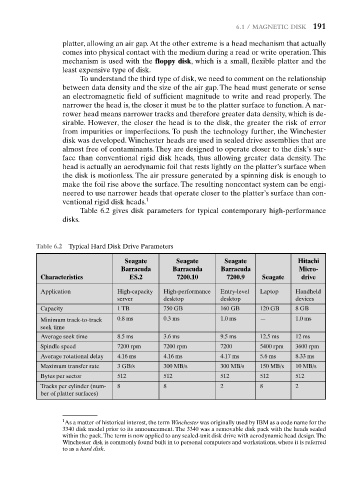
                       Table 6.2 gives disk parameters for typical contemporary high-performance
                  disks.


           Table 6.2 Typical Hard Disk Drive Parameters
                                   Seagate       Seagate      Seagate             Hitachi
                                  Barracuda     Barracuda    Barracuda             Micro-
            Characteristics         ES.2         7200.10       7200.9    Seagate   drive

            Application          High-capacity  High-performance  Entry-level  Laptop  Handheld
                                 server       desktop        desktop              devices
            Capacity             1 TB         750 GB         160 GB     120 GB    8 GB
            Minimum track-to-track  0.8 ms    0.3 ms         1.0 ms     —         1.0 ms
            seek time
            Average seek time    8.5 ms       3.6 ms         9.5 ms     12.5 ms   12 ms
            Spindle speed        7200 rpm     7200 rpm       7200       5400 rpm  3600 rpm
            Average rotational delay  4.16 ms  4.16 ms       4.17 ms    5.6 ms    8.33 ms
            Maximum transfer rate  3 GB/s     300 MB/s       300 MB/s   150 MB/s  10 MB/s
            Bytes per sector     512          512            512        512       512
            Tracks per cylinder (num-  8      8              2          8         2
            ber of platter surfaces)


                  1 As a matter of historical interest, the term Winchester was originally used by IBM as a code name for the
                  3340 disk model prior to its announcement. The 3340 was a removable disk pack with the heads sealed
                  within the pack.The term is now applied to any sealed-unit disk drive with aerodynamic head design.The
                  Winchester disk is commonly found built in to personal computers and workstations, where it is referred
                  to as a hard disk.

