


Page 219 -
P. 219
6.1 / MAGNETIC DISK 187

                                                Sectors       Tracks

                        Intersector gap
                                                                       Intertrack gap
                                             S6           • • •


                                               S6       • • •

                                    S5                           SN   SN
                                         S5


                                           S4                     S1    S1
                                     S4            S3       S2


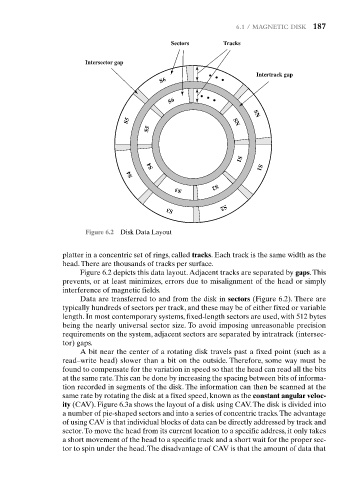
                        Figure 6.2 Disk Data Layout  S3        S2


                  platter in a concentric set of rings, called tracks. Each track is the same width as the
                  head.There are thousands of tracks per surface.
                       Figure 6.2 depicts this data layout.Adjacent tracks are separated by gaps.This
                  prevents, or at least minimizes, errors due to misalignment of the head or simply
                  interference of magnetic fields.
                       Data are transferred to and from the disk in sectors (Figure 6.2). There are
                  typically hundreds of sectors per track, and these may be of either fixed or variable
                  length. In most contemporary systems, fixed-length sectors are used, with 512 bytes
                  being the nearly universal sector size. To avoid imposing unreasonable precision
                  requirements on the system, adjacent sectors are separated by intratrack (intersec-
                  tor) gaps.
                       A bit near the center of a rotating disk travels past a fixed point (such as a
                  read–write head) slower than a bit on the outside. Therefore, some way must be
                  found to compensate for the variation in speed so that the head can read all the bits
                  at the same rate.This can be done by increasing the spacing between bits of informa-
                  tion recorded in segments of the disk. The information can then be scanned at the
                  same rate by rotating the disk at a fixed speed, known as the constant angular veloc-
                  ity (CAV). Figure 6.3a shows the layout of a disk using CAV.The disk is divided into
                  a number of pie-shaped sectors and into a series of concentric tracks.The advantage
                  of using CAV is that individual blocks of data can be directly addressed by track and
                  sector.To move the head from its current location to a specific address, it only takes
                  a short movement of the head to a specific track and a short wait for the proper sec-
                  tor to spin under the head.The disadvantage of CAV is that the amount of data that

