


Page 553 - Design for Six Sigma a Roadmap for Product Development
P. 553
512   Chapter Fourteen

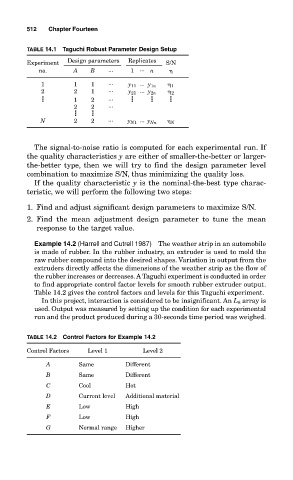
           TABLE 14.1 Taguchi Robust Parameter Design Setup

           Experiment  Design parameters  Replicates  S/N
               no.      A    B   ...    1  ...  n
               1        1    1   ...   y 11  ... y 1n    1
               2        2    1   ...   y 21  ... y 2n    2
                        1    2   ...
                        2    2   ...

               N        2    2   ...   y N1  ... y Nn    N


             The signal-to-noise ratio is computed for each experimental run. If
           the quality characteristics y are either of smaller-the-better or larger-
           the-better type, then we will try to find the design parameter level
           combination to maximize S/N, thus minimizing the quality loss.
             If the quality characteristic y is the nominal-the-best type charac-
           teristic, we will perform the following two steps:

           1. Find and adjust significant design parameters to maximize S/N.
           2. Find the mean adjustment design parameter to tune the mean
              response to the target value.
             Example 14.2 (Harrell and Cutrell 1987) The weather strip in an automobile
             is made of rubber. In the rubber industry, an extruder is used to mold the
             raw rubber compound into the desired shapes. Variation in output from the
             extruders directly affects the dimensions of the weather strip as the flow of
             the rubber increases or decreases. A Taguchi experiment is conducted in order
             to find appropriate control factor levels for smooth rubber extruder output.
             Table 14.2 gives the control factors and levels for this Taguchi experiment.
               In this project, interaction is considered to be insignificant. An L 8 array is
             used. Output was measured by setting up the condition for each experimental
             run and the product produced during a 30-seconds time period was weighed.

           TABLE 14.2 Control Factors for Example 14.2

           Control Factors  Level 1        Level 2
                 A        Same        Different
                 B        Same        Different
                 C        Cool        Hot
                 D        Current level  Additional material
                 E        Low         High
                 F        Low         High
                 G        Normal range  Higher

