


Page 601 - Dynamics of Mechanical Systems
P. 601
0593_C17_fm  Page 582  Tuesday, May 7, 2002  7:12 AM


                       582                                                 Dynamics of Mechanical Systems


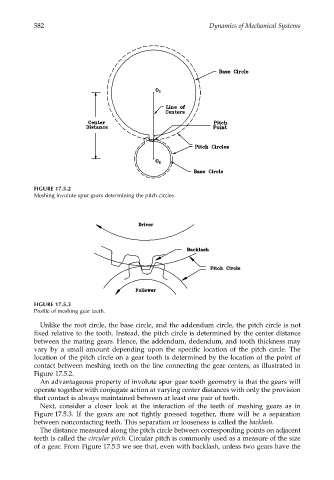
                       FIGURE 17.5.2
                       Meshing involute spur gears determining the pitch circles.


                       FIGURE 17.5.3
                       Profile of meshing gear teeth.

                        Unlike the root circle, the base circle, and the addendum circle, the pitch circle is not
                       fixed relative to the tooth. Instead, the pitch circle is determined by the center distance
                       between the mating gears. Hence, the addendum, dedendum, and tooth thickness may
                       vary by a small amount depending upon the specific location of the pitch circle. The
                       location of the pitch circle on a gear tooth is determined by the location of the point of
                       contact between meshing teeth on the line connecting the gear centers, as illustrated in
                       Figure 17.5.2.
                        An advantageous property of involute spur gear tooth geometry is that the gears will
                       operate together with conjugate action at varying center distances with only the provision
                       that contact is always maintained between at least one pair of teeth.
                        Next, consider a closer look at the interaction of the teeth of meshing gears as in
                       Figure 17.5.3. If the gears are not tightly pressed together, there will be a separation
                       between noncontacting teeth. This separation or looseness is called the backlash.
                        The distance measured along the pitch circle between corresponding points on adjacent
                       teeth is called the circular pitch. Circular pitch is commonly used as a measure of the size
                       of a gear. From Figure 17.5.3 we see that, even with backlash, unless two gears have the

