


Page 125 - Electromechanical Devices and Components Illustrated Sourcebook
P. 125
Chapter 5  Magnetic Components 87

                                                              Isolation Transformers

                                                              The transformers discussed thus far are constructed with two
                                                              separate coils, therefore the inputs and the outputs are electri-
                                                              cally isolated. This type of design is generally referred to as
                                                              an isolation transformer and the level of isolation is a function
                                                              of the insulation between the coils and/or the core. Usually,
                  Schematic Symbol                            the level of isolation is given in volts. Isolation transformers
                                                              are particularly useful for electrically detaching a sensitive
                                                              application from a noisy power source. The most notable use
                                                              of isolation transformers is for home and business power dis-
                                                              tribution. Power transformers mounted on the poles electrically
                                               Input
                                                              isolate power drops from the distribution grid and  therefore
                                                              protect homes and businesses from the high-voltage transients
                                                              that routinely occur.

                                                 Output
                                                              Autotransformers
                                              W/ Center Tap
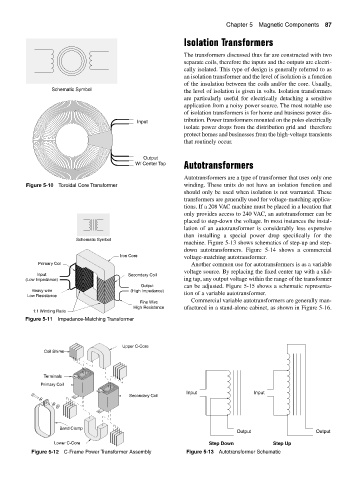
                                                              Autotransformers are a type of transformer that uses only one
          Figure 5-10 Toroidal Core Transformer               winding. These units do not have an isolation function and
                                                              should only be used when isolation is not warranted. These
                                                              transformers are generally used for voltage-matching applica-
                                                              tions. If a 208 VAC machine must be placed in a location that
                                                              only provides access to 240 VAC, an autotransformer can be
                                                              placed to step-down the voltage. In most instances the instal-
                                                              lation of an autotransformer is considerably less expensive
                                                              than installing a special power drop specifically for the
                          Schematic Symbol
                                                              machine. Figure 5-13 shows schematics of step-up and step-
                                                              down autotransformers. Figure 5-14 shows a commercial
                                         Iron Core            voltage-matching autotransformer.
              Primary Coil                                       Another common use for autotransformers is as a variable
                                                              voltage source. By replacing the fixed center tap with a slid-
             Input                          Secondary Coil
          (Low Impedance)                                     ing tap, any output voltage within the range of the transformer
                                                Output        can be adjusted. Figure 5-15 shows a schematic representa-
            Heavy wire                       (High Impedance)
          Low Resistance                                      tion of a variable autotransformer.
                                                                 Commercial variable autotransformers are generally man-
                                                Fine Wire
                                              High Resistance  ufactured in a stand-alone cabinet, as shown in Figure 5-16.
            1:1 Winding Ratio
          Figure 5-11 Impedance-Matching Transformer


                                          Upper C-Core
                Coil Shims


                Terminals
               Primary Coil
                                                               Input                  Input
                                            Secondary Coil


                     Band Clamp
                                                                                Output                    Output
                   Lower C-Core                                        Step Down            Step Up
            Figure 5-12 C-Frame Power Transformer Assembly     Figure 5-13 Autotransformer Schematic

