


Page 348 - Elements of Distribution Theory
P. 348
P1: JZP
            052184472Xc11  CUNY148/Severini  May 24, 2005  17:56


                            334                 Approximation of Probability Distributions

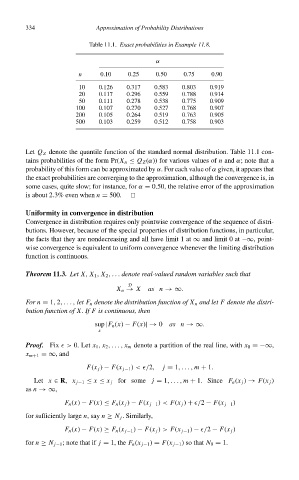
                                              Table 11.1. Exact probabilities in Example 11.8.

                                                                 α

                                           n     0.10    0.25    0.50    0.75    0.90
                                           10    0.126   0.317   0.583   0.803   0.919
                                           20    0.117   0.296   0.559   0.788   0.914
                                           50    0.111   0.278   0.538   0.775   0.909
                                          100    0.107   0.270   0.527   0.768   0.907
                                          200    0.105   0.264   0.519   0.763   0.905
                                          500    0.103   0.259   0.512   0.758   0.903


                            Let Q Z denote the quantile function of the standard normal distribution. Table 11.1 con-
                            tains probabilities of the form Pr(X n ≤ Q Z (α)) for various values of n and α; note that a
                            probability of this form can be approximated by α.For each value of α given, it appears that
                            the exact probabilities are converging to the approximation, although the convergence is, in
                            some cases, quite slow; for instance, for α = 0.50, the relative error of the approximation
                            is about 2.3% even when n = 500.

                            Uniformity in convergence in distribution
                            Convergence in distribution requires only pointwise convergence of the sequence of distri-
                            butions. However, because of the special properties of distribution functions, in particular,
                            the facts that they are nondecreasing and all have limit 1 at ∞ and limit 0 at −∞, point-
                            wise convergence is equivalent to uniform convergence whenever the limiting distribution
                            function is continuous.


                            Theorem 11.3. Let X, X 1 , X 2 ,... denote real-valued random variables such that
                                                         D
                                                      X n → X  as n →∞.
                            For n = 1, 2,..., let F n denote the distribution function of X n and let F denote the distri-
                            bution function of X. If F is continuous, then
                                                sup |F n (x) − F(x)|→ 0  as n →∞.
                                                 x
                            Proof. Fix  > 0. Let x 1 , x 2 ,..., x m denote a partition of the real line, with x 0 =−∞,
                            x m+1 =∞, and
                                             F(x j ) − F(x j−1 ) < /2,  j = 1,..., m + 1.

                              Let x ∈ R, x j−1 ≤ x ≤ x j for some j = 1,..., m + 1. Since F n (x j ) → F(x j )
                            as n →∞,

                                       F n (x) − F(x) ≤ F n (x j ) − F(x j−1 ) < F(x j ) +  /2 − F(x j−1 )
                            for sufficiently large n, say n ≥ N j . Similarly,

                                       F n (x) − F(x) ≥ F n (x j−1 ) − F(x j ) > F(x j−1 ) −  /2 − F(x j )
                            for n ≥ N j−1 ; note that if j = 1, the F n (x j−1 ) = F(x j−1 )so that N 0 = 1.

