


Page 343 - Elements of Distribution Theory
P. 343
P1: JZP
            052184472Xc11  CUNY148/Severini  May 24, 2005  17:56


                                        11.2 Basic Properties of Convergence in Distribution  329

                        Hence, for all x 1 , x 2 ,

                                                 |h(x 1 ) − h(x 2 )|≤|x 1 − x 2 |

                        so that, for a given value of t and a given  > 0,
                                                   |h t (x 1 ) − h t (x 2 )|≤

                        whenever
                                                     |x 1 − x 2 |≤  /t.

                        It follows that h t is uniformly continuous and, hence, for all t > 0,
                                                 lim E[h t (X n )] = E[h t (X)].
                                                 n→∞
                          The proof of the corollary now follows as in the proof of Theorem 11.1.


                          The requirements in Theorem 11.1 that f is bounded and continuous are crucial for
                        the conclusion of the theorem. The following examples illustrate that convergence of the
                        expected values need not hold if these conditions are not satisfied.

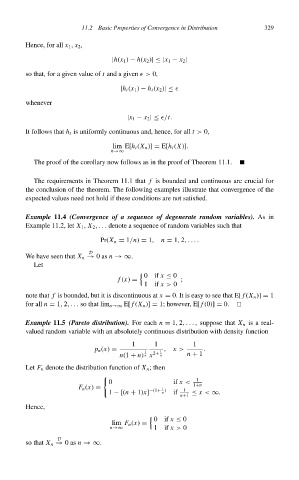
                        Example 11.4 (Convergence of a sequence of degenerate random variables). As in
                        Example 11.2, let X 1 , X 2 ,... denote a sequence of random variables such that
                                              Pr(X n = 1/n) = 1,  n = 1, 2,....

                                          D
                        We have seen that X n → 0as n →∞.
                          Let
                                                          0if x ≤ 0

                                                   f (x) =           ;
                                                          1if x > 0
                        note that f is bounded, but it is discontinuous at x = 0. It is easy to see that E[ f (X n )] = 1
                        for all n = 1, 2,... so that lim n→∞ E[ f (X n )] = 1; however, E[ f (0)] = 0.

                        Example 11.5 (Pareto distribution). For each n = 1, 2,..., suppose that X n is a real-
                        valued random variable with an absolutely continuous distribution with density function
                                                       1     1          1
                                            p n (x) =     1    1  ,  x >   .
                                                   n(1 + n) n x  2+  n  n + 1
                        Let F n denote the distribution function of X n ; then

                                                                         1
                                                0                  if x <  1+n
                                       F n (x) =            −(1+ )    1
                                                               1
                                                1 − [(n + 1)x]  n  if   ≤ x < ∞.
                                                                     n+1
                        Hence,
                                                             0if x ≤ 0

                                                 lim F n (x) =
                                                n→∞          1if x > 0
                                 D
                        so that X n → 0as n →∞.

