


Page 347 - Elements of Distribution Theory
P. 347
P1: JZP
            052184472Xc11  CUNY148/Severini  May 24, 2005  17:56


                                        11.2 Basic Properties of Convergence in Distribution  333

                        It follows that from Theorem 11.2
                                                     D
                                              X n + Y → X + Y 0  as n →∞,
                        where Y 0 denotes a random variable that is independent of X and has the same marginal
                        distribution as Y.

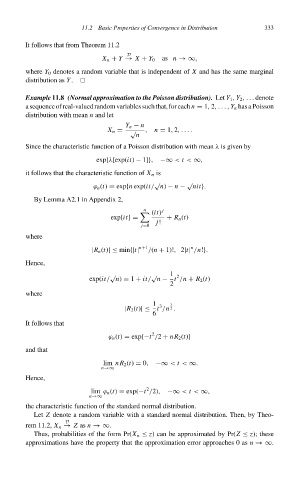
                        Example 11.8 (Normal approximation to the Poisson distribution). Let Y 1 , Y 2 ,... denote
                        asequenceofreal-valuedrandomvariablessuchthat,foreachn = 1, 2,...,Y n hasaPoisson
                        distribution with mean n and let
                                                     Y n − n
                                                X n =  √   ,  n = 1, 2,....
                                                        n
                        Since the characteristic function of a Poisson distribution with mean λ is given by

                                            exp{λ[exp(it) − 1]},  −∞ < t < ∞,
                        it follows that the characteristic function of X n is
                                                             √         √
                                            ϕ n (t) = exp{n exp(it/ n) − n −  nit}.
                          By Lemma A2.1 in Appendix 2,
                                                          n    j
                                                            (it)
                                                 exp{it}=        + R n (t)
                                                              j!
                                                         j=0
                        where
                                                         n+1            n
                                           |R n (t)|≤ min{|t|  /(n + 1)!, 2|t| /n!}.
                        Hence,
                                                √           √     1  2
                                          exp(it/ n) = 1 + it/ n − t /n + R 2 (t)
                                                                  2
                        where
                                                             1  3  3
                                                    |R 2 (t)|≤  t /n 2 .
                                                             6
                        It follows that
                                                            2
                                                ϕ n (t) = exp{−t /2 + nR 2 (t)}
                        and that

                                              lim nR 2 (t) = 0,  −∞ < t < ∞.
                                              n→∞
                        Hence,
                                                           2
                                           lim ϕ n (t) = exp(−t /2),  −∞ < t < ∞,
                                          n→∞
                        the characteristic function of the standard normal distribution.
                          Let Z denote a random variable with a standard normal distribution. Then, by Theo-
                                   D
                        rem 11.2, X n → Z as n →∞.
                          Thus, probabilities of the form Pr(X n ≤ z) can be approximated by Pr(Z ≤ z); these
                        approximations have the property that the approximation error approaches 0 as n →∞.

