


Page 346 - Elements of Distribution Theory
P. 346
P1: JZP
            052184472Xc11  CUNY148/Severini  May 24, 2005  17:56


                            332                 Approximation of Probability Distributions

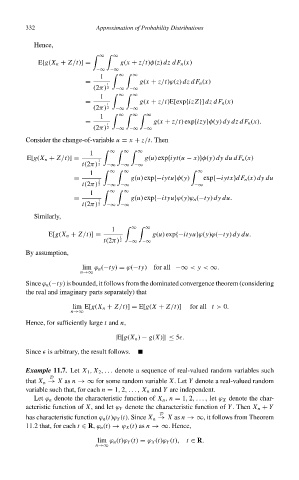
                              Hence,
                                                 ∞   ∞

                               E[g(X n + Z/t)] =       g(x + z/t)φ(z) dz dF n (x)
                                                −∞  −∞
                                                 1      ∞     ∞
                                             =               g(x + z/t)ϕ(z) dz dF n (x)
                                                   1
                                               (2π) 2  −∞  −∞
                                                 1      ∞     ∞
                                             =               g(x + z/t)E[exp{izZ}] dz dF n (x)
                                                   1
                                               (2π) 2  −∞  −∞
                                                 1      ∞     ∞     ∞
                                             =                   g(x + z/t)exp{izy}φ(y) dy dz dF n (x).
                                                   1
                                               (2π) 2  −∞  −∞  −∞
                            Consider the change-of-variable u = x + z/t. Then
                                              1      ∞     ∞     ∞
                            E[g(X n + Z/t)] =                 g(u)exp{iyt(u − x)}φ(y) dy du dF n (x)
                                                 1
                                            t(2π) 2  −∞  −∞  −∞
                                              1      ∞     ∞                   ∞
                                          =               g(u)exp{−iytu}φ(y)   exp{−iytx}dF n (x) dy du
                                                 1
                                            t(2π) 2  −∞  −∞                  −∞
                                              1      ∞     ∞
                                          =               g(u)exp{−ityu}ϕ(y)ϕ n (−ty) dy du.
                                                 1
                                            t(2π) 2  −∞  −∞
                              Similarly,
                                                     1     ∞     ∞
                                  E[g(X n + Z/t)] =             g(u)exp{−ityu}ϕ(y)ϕ(−ty) dy du.
                                                       1
                                                  t(2π) 2  −∞  −∞
                            By assumption,
                                            lim ϕ n (−ty) = ϕ(−ty)  for all −∞ < y < ∞.
                                            n→∞
                            Since ϕ n (−ty)is bounded, it follows from the dominated convergence theorem (considering
                            the real and imaginary parts separately) that
                                         lim E[g(X n + Z/t)] = E[g(X + Z/t)]  for all t > 0.
                                         n→∞
                            Hence, for sufficiently large t and n,

                                                      |E[g(X n ) − g(X)]|≤ 5 .

                            Since   is arbitrary, the result follows.

                            Example 11.7. Let X 1 , X 2 ,... denote a sequence of real-valued random variables such
                                   D
                            that X n → X as n →∞ for some random variable X. Let Y denote a real-valued random
                            variable such that, for each n = 1, 2,..., X n and Y are independent.
                              Let ϕ n denote the characteristic function of X n , n = 1, 2,..., let ϕ X denote the char-
                            acteristic function of X, and let ϕ Y denote the characteristic function of Y. Then X n + Y
                                                                   D
                            has characteristic function ϕ n (t)ϕ Y (t). Since X n → X as n →∞,it follows from Theorem
                            11.2 that, for each t ∈ R, ϕ n (t) → ϕ X (t)as n →∞. Hence,

                                                 lim ϕ n (t)ϕ Y (t) = ϕ X (t)ϕ Y (t),  t ∈ R.
                                                n→∞

