


Page 342 - Elements of Distribution Theory
P. 342
P1: JZP
052184472Xc11 CUNY148/Severini May 24, 2005 17:56
328 Approximation of Probability Distributions
and, for any value of t > 0,
lim inf F n (x) ≥ lim E[h t (X n − x + 1/t)] = E[h t (X n − x + 1/t)] ≥ F(x + 1/t).
n→∞ n→∞
It follows that
lim inf F n (x) ≥ F(x − 1/t), t > 0
n→∞
and, hence, that
lim inf F n (x) ≥ F(x) (11.2)
n→∞
provided that F is continuous at x.
Combining (11.1) and (11.2), it follows that
lim F n (x) = F(x)
n→∞
at all continuity points x of F, proving the theorem.
It can be shown that the function h t used in the proof of Theorem 11.1 is not only
D
continuous, it is uniformly continuous. Hence, X n → X as n →∞ provided only that
E[ f (X n )] → E[ f (X)] as n →∞
for all bounded, uniformly continuous, real-valued functions f . Since the class of all
bounded, uniformly continuous functions is smaller than the class of all bounded, con-
tinuous functions, this gives a slightly weaker condition for convergence in distribution that
is sometimes useful. The details of the argument are given in following corollary.
Corollary 11.1. Let X 1 , X 2 ,... denote a sequence of real-valued random variables and let
X denote a real-valued random variable. If
E[ f (X n )] → E[ f (X)] as n →∞
for all bounded, uniformly continuous, real-valued functions f , then
D
X n → X as n →∞.
Proof. Suppose that E[ f (X n )] converges to E[ f (X)] for all real-valued, bounded, uni-
formly continuous f .Asin the proof of Theorem 11.1, define
1 if x < 0
h(x) = 1 − x if 0 ≤ x ≤ 1
0 if x > 1
and for any t > 0 define h t (x) = h(tx).
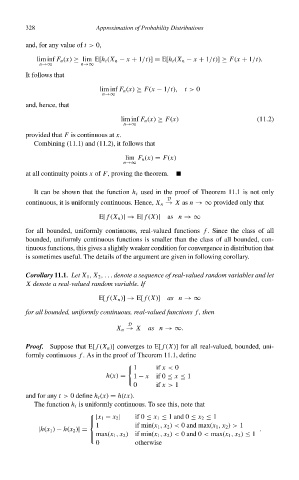
The function h t is uniformly continuous. To see this, note that
|x 1 − x 2 | if 0 ≤ x 1 ≤ 1 and 0 ≤ x 2 ≤ 1
1 if min(x 1 , x 2 ) < 0 and max(x 1 , x 2 ) > 1
|h(x 1 ) − h(x 2 )|= .
max(x 1 , x 2 )if min(x 1 , x 2 ) < 0 and 0 < max(x 1 , x 2 ) ≤ 1
0 otherwise

