


Page 100 - Academic Press Encyclopedia of Physical Science and Technology 3rd InOrganic Chemistry
P. 100
P1: GLM/GLT  P2: FQP Final Pages
 Encyclopedia of Physical Science and Technology  En004F-171  June 8, 2001  17:11


              Dielectric Gases                                                                            367


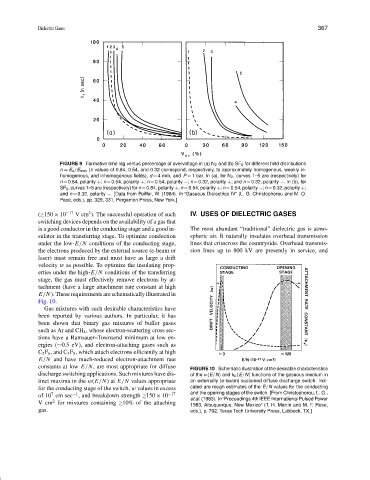
                     FIGURE 9  Formative time lag versus percentage of overvoltage in (a) N 2  and (b) SF 6  for different field distributions
                     n ≡ E a  /E max  (n values of 0.84, 0.54, and 0.32 correspond, respectively, to approximately homogenous, weakly in-
                     homogenous, and inhomogenous fields), d = 4 mm, and P = 1 bar. In (a), for N 2 , curves 1–5 are (respectively) for
                     n = 0.84, polarity +; n = 0.54, polarity +; n = 0.54, polarity −; n = 0.32, polarity +; and n = 0.32, polarity −. In (b), for
                     SF 6 , curves 1–5 are (respectively) for n = 0.84, polarity +; n = 0.54, polarity +; n = 0.54, polarity −; n = 0.32, polarity +;
                     and n = 0.32, polarity −. [Data from Peiffer, W. (1984). In “Gaseous Dielectrics IV” (L. G. Christophorou and M. O.
                     Pace, eds.), pp. 329, 331, Pergamon Press, New York.]

                              2
              ( 150 × 10 −17  V cm ). The successful operation of such  IV. USES OF DIELECTRIC GASES
              switching devices depends on the availability of a gas that
              is a good conductor in the conducting stage and a good in-  The most abundant “traditional” dielectric gas is atmo-
              sulator in the transferring stage. To optimize conduction  spheric air. It naturally insulates overhead transmission
              under the low-E /N  conditions of the conducting stage,  lines that crisscross the countryside. Overhead transmis-
              the electrons produced by the external source (e-beam or  sion lines up to 800 kV are presently in service, and
              laser)  must  remain  free  and  must  have  as  large  a  drift
              velocity w as possible. To optimize the insulating prop-
              erties under the high-E /N  conditions of the transferring
              stage, the gas must effectively remove electrons by at-
              tachment (have a large attachment rate constant at high
              E /N). These requirements are schematically illustrated in
              Fig. 10.
                Gas mixtures with such desirable characteristics have
              been  reported  by  various  authors.  In  particular,  it  has
              been  shown  that  binary  gas  mixtures  of  buffer  gases
              such as Ar and CH 4 , whose electron-scattering cross sec-
              tions have a Ramsauer–Townsend minimum at low en-
              ergies  (∼0.5  eV),  and  electron-attaching  gases  such  as
              C 2 F 6 , and C 3 F 8 , which attach electrons efficiently at high
              E /N  and  have  much-reduced  electron-attachment  rate
              constants at low  E /N, are most appropriate for diffuse  FIGURE 10 Schematic illustration of the desirable characteristics
              discharge switching applications. Such mixtures have dis-  of the w(E/N) and k a (E/N) functions of the gaseous medium in
              tinct maxima in the w(E /N) at E /N  values appropriate  an externally (e-beam) sustained diffuse discharge switch. Indi-
              for the conducting stage of the switch, w values in excess  cated are rough estimates of the E/N values for the conducting
                  7
                         −1
              of 10 cm sec , and breakdown strength  150 × 10 −17  and the opening stages of the switch. [From Christophorou, L. G.,
                                                                et al. (1983). In “Proceedings 4th IEEE International Pulsed Power
                  2
              Vcm for mixtures containing  10% of the attaching  1983, Albuquerque, New Mexico” (T. H. Martin and M. F. Rose,
              gas.                                              eds.), p. 702, Texas Tech University Press, Lubbock, TX.]

