


Page 97 - Academic Press Encyclopedia of Physical Science and Technology 3rd InOrganic Chemistry
P. 97
P1: GLM/GLT  P2: FQP Final Pages
 Encyclopedia of Physical Science and Technology  En004F-171  June 8, 2001  17:11


               364                                                                                    Dielectric Gases


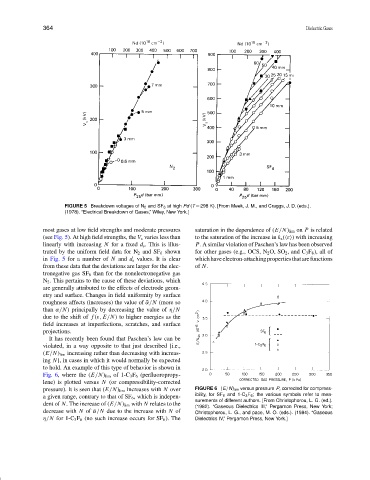
                      FIGURE 5  Breakdown voltages of N 2  and SF 6  at high Pd (T = 298 K). [From Meek, J. M., and Craggs, J. D. (eds.).
                      (1978). “Electrical Breakdown of Gases,” Wiley, New York.]

               most gases at low field strengths and moderate pressures  saturation in the dependence of (E/N) lim on P is related
               (see Fig. 5). At high field strengths, the V s  varies less than  to the saturation of the increase in k a ( ε ) with increasing
               linearly with increasing  N  for a fixed d s . This is illus-  P. A similar violation of Paschen’s law has been observed
               trated by the uniform field data for N 2  and SF 6  shown  for other gases (e.g., OCS, N 2 O, SO 2 , and C 3 F 8 ), all of
               in  Fig.  5  for  a  number  of  N  and  d s  values.  It  is  clear  whichhaveelectron-attachingpropertiesthatarefunctions
               from these data that the deviations are larger for the elec-  of N.
               tronegative gas SF 6  than for the nonelectronegative gas
               N 2 . This pertains to the cause of these deviations, which
               are generally attributed to the effects of electrode geom-
               etry and surface. Changes in field uniformity by surface
               roughness affects (increases) the value of  ¯α/N  (more so
               than α/N) principally by decreasing the value of η/N
               due to the shift of  f (ε, E /N) to higher energies as the
               field  increases  at  imperfections,  scratches,  and  surface
               projections.
                 It has recently been found that Paschen’s law can be
               violated,  in  a  way  opposite  to  that  just  described  [i.e.,
               (E /N) lim  increasing rather than decreasing with increas-
               ing N], in cases in which it would normally be expected
               to hold. An example of this type of behavior is shown in
               Fig. 6, where the (E /N) lim of 1-C 3 F 6 (perfluoropropy-
               lene) is plotted versus N (or compressibility-corrected
               pressure). It is seen that (E/N) lim increases with N over  FIGURE 6 (E/N) lim versus pressure P, corrected for compress-
               a given range, contrary to that of SF 6 , which is indepen-  ibility, for SF 6 and 1-C 3 F 6 ; the various symbols refer to mea-
                                                                 surements of different authors. [From Christophorou, L. G. (ed.).
               dent of N. The increase of (E/N) lim with N relates to the
                                                                 (1982). “Gaseous Dielectrics III,” Pergamon Press, New York;
               decrease with N of ¯α/N due to the increase with N of  Christophorou, L. G., and pace, M. O. (eds.). (1984). “Gaseous
               η/N for 1-C 3 F 6 (no such increase occurs for SF 6 ). The  Dielectrics IV,” Pergamon Press, New York.]

