


Page 98 - Academic Press Encyclopedia of Physical Science and Technology 3rd InOrganic Chemistry
P. 98
P1: GLM/GLT  P2: FQP Final Pages
 Encyclopedia of Physical Science and Technology  En004F-171  June 8, 2001  17:11


              Dielectric Gases                                                                            365

              B.  Nonuniform Fields                             form the field), the higher the value of  P c  (i.e., corona
                                                                stabilization occurs over a wider range of pressures).
              A nonuniform field is often characterized by the so-called
                                                                  Under impulse conditions, the behavior of V s  at P > P 1
              field utilization factor n, defined as the ratio of the aver-
                                                                depends on the impulse risetime and on the availability of
              age field E a  to the maximum field E m , and is a function
                                                                initiatingelectrons(i.e.,thebehaviorisstronglydependent
              of the electrode geometry. When the maximum electri-
                                                                on the statistics of discharge initiation). For wavefronts
              cal stress in a gas gap is large enough, localized ioniza-
                                                                 100 µsec, there is time for corona shielding to develop,
              tion occurs near the high-field electrode without break-
                                                                and the V s  versus P curve is similar to that for dc. For short
              down. This phenomenon is generally known as corona.
                                                                risetimes (a few microseconds or less), the characteristic
              The charges generated by corona are separated by the elec-
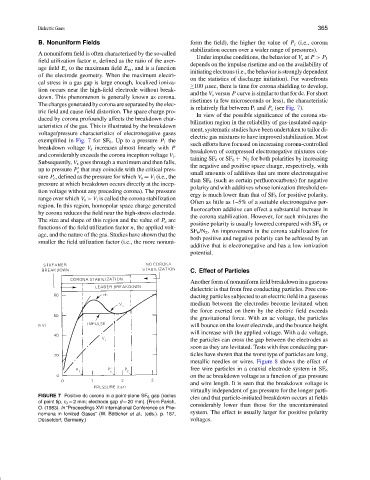
                                                                is relatively flat between P i  and P c  (see Fig. 7).
              tric field and cause field distortion. The space charge pro-
                                                                  In view of the possible significance of the corona sta-
              duced by corona profoundly affects the breakdown char-
                                                                bilization region in the reliability of gas-insulated equip-
              acteristics of the gas. This is illustrated by the breakdown
                                                                ment, systematic studies have been undertaken to tailor di-
              voltage/pressure characteristics of electronegative gases
                                                                electric gas mixtures to have improved stabilization. Most
              exemplified in Fig. 7 for SF 6 . Up to a pressure  P 1  the
                                                                such efforts have focused on increasing corona-controlled
              breakdown voltage V s  increases almost linearly with  P
                                                                breakdown of compressed electronegative mixtures con-
              and considerably exceeds the corona inception voltage V i .
                                                                taining SF 6  or SF 6  +  N 2  for both polarities by increasing
              Subsequently, V s  goes through a maximum and then falls,
                                                                the negative and positive space charge, respectively, with
              up to pressure P  that may coincide with the critical pres-  small amounts of additives that are more electronegative

                          c
              sure P c , defined as the pressure for which V s  = V i  (i.e., the
                                                                than SF 6  (such as certain perfluorocarbons) for negative
              pressure at which breakdown occurs directly at the incep-
                                                                polarity and with additives whose ionization threshold en-
              tion voltage without any preceding corona). The pressure
                                                                ergy is much lower than that of SF 6  for positive polarity.
              range over which V s  > V i  is called the corona stabilization
                                                                Often as little as 1–5% of a suitable electronegative per-
              region. In this region, homopolar space charge generated
                                                                fluorocarbon additive can effect a substantial increase in
              by corona reduces the field near the high-stress electrode.
                                                                the corona stabilization. However, for such mixtures the
              The size and shape of this region and the value of P c  are
                                                                positive polarity is usually lowered compared with SF 6  or
              functions of the field utilization factor n, the applied volt-
                                                                SF 6 /N 2 . An improvement in the corona stabilization for
              age, and the nature of the gas. Studies have shown that the
                                                                both positive and negative polarity can be achieved by an
              smaller the field utilization factor (i.e., the more nonuni-
                                                                additive that is electronegative and has a low ionization
                                                                potential.
                                                                C.  Effect of Particles
                                                                Another form of nonuniform field breakdown in a gaseous
                                                                dielectric is that from free conducting particles. Free con-
                                                                ducting particles subjected to an electric field in a gaseous
                                                                medium between the electrodes become levitated when
                                                                the force exerted on them by the electric field exceeds
                                                                the gravitational force. With an ac voltage, the particles
                                                                will bounce on the lower electrode, and the bounce height
                                                                will increase with the applied voltage. With a dc voltage,
                                                                the particles can cross the gap between the electrodes as
                                                                soon as they are levitated. Tests with free conducting par-
                                                                ticles have shown that the worst type of particles are long,
                                                                metallic needles or wires. Figure 8 shows the effect of
                                                                free wire particles in a coaxial electrode system in SF 6
                                                                on the ac breakdown voltage as a function of gas pressure
                                                                and wire length. It is seen that the breakdown voltage is
                                                                virtually independent of gas pressure for the longer parti-
              FIGURE 7  Positive dc corona in a point-plane SF 6  gap (radius
                                                                cles and that particle-initiated breakdown occurs at fields
              of point tip, r 0  = 2 mm; electrode gap d = 20 mm). [From Farish,
                                                                considerably lower than those for the uncontaminated
              O. (1983). In “Proceedings XVI International Conference on Phe-
                                                                system. The effect is usually larger for positive polarity
              nomena  in  Ionized  Gases”  (W.  B¨otticher  et  al.,  (eds.).  p.  187,
              D¨usseldorf, Germany.)                            voltages.

