


Page 99 - Academic Press Encyclopedia of Physical Science and Technology 3rd InOrganic Chemistry
P. 99
P1: GLM/GLT  P2: FQP Final Pages
 Encyclopedia of Physical Science and Technology  En004F-171  June 8, 2001  17:11


               366                                                                                    Dielectric Gases


                                                                 D.  Voltage Waveform Effects
                                                                    and Time to Breakdown
                                                                 When a voltage of sufficient magnitude (≥V s  for dc) is
                                                                 suddenly applied to a gas-insulated electrode gap, or a
                                                                 gas-insulated  conductor,  breakdown  does  not  occur  in-
                                                                 stantaneously, but after a finite time t = t s  + t f . The t s  is
                                                                 called the statistical time lag and is the time that elapses
                                                                 between the application of the voltage V (≥V s ) and the
                                                                 occurrence of a free electron in the stressed gas volume
                                                                 which initiates the breakdown process. The t f  is called
                                                                 the formative time lag and is the time interval between
                                                                 the occurrence of the free electron and the collapse of the
                                                                 voltage (i.e., breakdown).
                                                                   The statistical time lag t s  can vary from nanoseconds
                                                                 to milliseconds (or longer) depending on the time the ini-
                                                                 tiatory electron becomes available when  V ≥ V s . Initia-
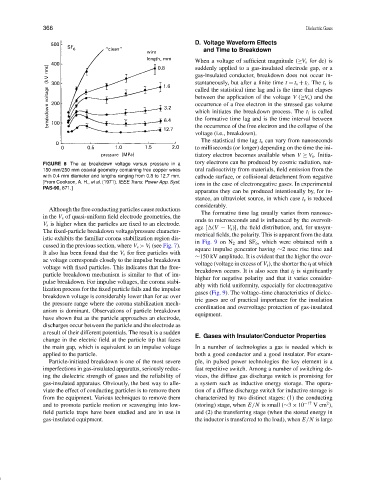
               FIGURE  8  The  ac  breakdown  voltage  versus  pressure  in  a  tory electrons can be produced by cosmic radiation, nat-
               150 mm/250 mm coaxial geometry containing free copper wires  ural radioactivity from materials, field emission from the
               with 0.4 mm diameter and lengths ranging from 0.8 to 12.7 mm.  cathode surface, or collisional detachment from negative
               [From Cookson, A. H., et al. (1971). IEEE Trans. Power App. Syst.  ions in the case of electronegative gases. In experimental
               PAS-90, 871.]
                                                                 apparatus they can be produced intentionally by, for in-
                                                                 stance, an ultraviolet source, in which case t s  is reduced
                                                                 considerably.
                 Although the free conducting particles cause reductions
                                                                   The formative time lag usually varies from nanosec-
               in the V s  of quasi-uniform field electrode geometries, the
                                                                 onds to microseconds and is influenced by the overvolt-
               V s  is higher when the particles are fixed to an electrode.
                                                                 age [ (V  − V s )], the field distribution, and, for unsym-
               The fixed-particle breakdown voltage/pressure character-
                                                                 metrical fields, the polarity. This is apparent from the data
               istic exhibits the familiar corona stabilization region dis-
                                                                 in  Fig.  9  on  N 2  and  SF 6 ,  which  were  obtained  with  a
               cussed in the previous section, where V s  > V i  (see Fig. 7).
                                                                 square impulse generator having ∼2 nsec rise time and
               It also has been found that the V s  for free particles with
                                                                 ∼150 kV amplitude. It is evident that the higher the over-
               ac voltage corresponds closely to the impulse breakdown
                                                                 voltage (voltage in excess of V s ), the shorter the t f  at which
               voltage with fixed particles. This indicates that the free-
                                                                 breakdown occurs. It is also seen that t f  is significantly
               particle breakdown mechanism is similar to that of im-
                                                                 higher for negative polarity and that it varies consider-
               pulse breakdown. For impulse voltages, the corona stabi-
                                                                 ably with field uniformity, especially for electronegative
               lization process for the fixed particle fails and the impulse
                                                                 gases (Fig. 9). The voltage–time characteristics of dielec-
               breakdown voltage is considerably lower than for ac over
                                                                 tric gases are of practical importance for the insulation
               the pressure range where the corona stabilization mech-
                                                                 coordination and overvoltage protection of gas-insulated
               anism is dominant. Observations of particle breakdown
                                                                 equipment.
               have shown that as the particle approaches an electrode,
               discharges occur between the particle and the electrode as
               a result of their different potentials. The result is a sudden
                                                                 E. Gases with Insulator/Conductor Properties
               change in the electric field at the particle tip that faces
               the main gap, which is equivalent to an impulse voltage  In a number of technologies a gas is needed which is
               applied to the particle.                          both a good conductor and a good insulator. For exam-
                 Particle-initiated breakdown is one of the most severe  ple, in pulsed power technologies the key element is a
               imperfections in gas-insulated apparatus, seriously reduc-  fast repetitive switch. Among a number of switching de-
               ing the dielectric strength of gases and the reliability of  vices, the diffuse gas discharge switch is promising for
               gas-insulated apparatus. Obviously, the best way to alle-  a system such as inductive energy storage. The opera-
               viate the effect of conducting particles is to remove them  tion of a diffuse discharge switch for inductive storage is
               from the equipment. Various techniques to remove them  characterized by two distinct stages: (1) the conducting
                                                                                                             2
               and to promote particle motion or scavenging into low-  (storing) stage, when E/N is small (∼3 × 10 −17  Vcm ),
               field particle traps have been studied and are in use in  and (2) the transferring stage (when the stored energy in
               gas-insulated equipment.                          the inductor is transferred to the load), when E/N is large

