


Page 273 - Engineered Interfaces in Fiber Reinforced Composites
P. 273
2 54              Engineered interfaces in fiber reinforced composites


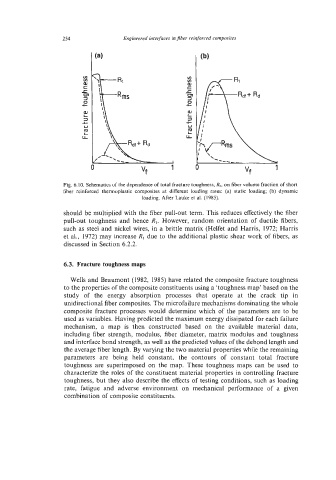
                    Fig. 6.10. Schematics of the dependence of total fracture toughness, R,, on fiber volume fraction of short
                    fiber  reinforced  thermoplastic composites at  different  loading  rates:  (a)  static loading;  (b) dynamic
                                            loading. After Lauke et al. (1985).

                    should be multiplied with the fiber pull-out term. This reduces effectively the fiber
                    pull-out  toughness and hence Rt. However,  random  orientation  of  ductile  fibers,
                    such as steel and nickel wires, in a brittle matrix (Helfet and Harris,  1972; Harris
                    et al.,  1972) may increase Rt due to the additional  plastic shear work  of  fibers, as
                    discussed in Section 6.2.2.


                    6.3. Fracture toughness maps

                      Wells and Beaumont (1982, 1985) have related the composite fracture toughness
                    to the properties of the composite constituents using a ‘toughness map’ based on the
                    study  of  the  energy  absorption  processes  that  operate  at  the  crack  tip  in
                    unidirectional fiber composites. The microfailure mechanisms dominating the whole
                    composite fracture processes would  determine which of  the parameters  are to be
                    used as variables. Having predicted the maximum energy dissipated for each failure
                    mechanism,  a  map  is  then  constructed  based  on  the  available  material  data,
                    including  fiber strength,  modulus,  fiber diameter, matrix  modulus  and toughness
                    and interface bond strength, as well as the predicted values of the debond length and
                    the average fiber length. By varying the two material properties while the remaining
                    parameters  are  being  held  constant,  the  contours  of  constant  total  fracture
                    toughness  are  superimposed  on  the  map.  These  toughness maps  can  be  used  to
                    characterize the roles of the constituent material properties in controlling fracture
                    toughness,  but they also describe the effects of testing conditions, such as loading
                    rate,  fatigue  and  adverse  environment  on  mechanical  performance  of  a  given
                    combination of composite constituents.

