


Page 752 - Engineering Digital Design
P. 752
718        CHAPTER 14 / ASYNCHRONOUS STATE MACHINE DESIGN AND ANALYSIS


                                                                              At D = 5r p
                                At F = 5r n
                                  E    P
                  A(H)                                         A(H)
                                                                                             Effect of
                  B(H)                                         B(H)                       f d-trio
                                            Effect of
                                       ^ E-hazard
                  y^H)            1                            Vl(H)           I
                                — *i  r«— (2r n)                                            3T   r
                                                                                 ~~^    |*~ (  p ~ !Nv)
                  y 0(H)              1                        V 0(H)

                                                            ( V 0B(L)     ^J           LJ
                 y,A(L)         1                        Y 1 <  VlA(L)           I


                                                                                 r-i


                                                               Z(H)                  |     1
                                                                                             _ Error
                 V^CL)                                                                        output
                                    I
                               (a)                                                (b)

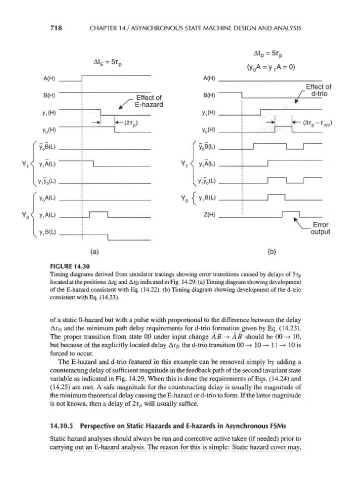
                    FIGURE 14.30
                    Timing diagrams derived from simulator tracings showing error transitions caused by delays of 5r p
                    located at the positions Afe and A?D indicated in Fig. 14.29. (a) Timing diagram showing development
                    of the E-hazard consistent with Eq. (14.22). (b) Timing diagram showing development of the d-trio
                    consistent with Eq. (14.23).


                    of a static 0-hazard but with a pulse width proportional to the difference between the delay
                    Af/) and the minimum path delay requirements for d-trio formation given by Eq. (14.23).
                    The proper transition from state 00 under input change AB -> AB should be 00-> 10,
                    but because of the explicitly located delay At D the d-trio transition 00 -> 10 —> 11-* 10 is
                    forced to occur.
                      The E-hazard and d-trio featured in this example can be removed simply by adding a
                    counteracting delay of sufficient magnitude in the feedback path of the second invariant state
                    variable as indicated in Fig. 14.29. When this is done the requirements of Eqs. (14.24) and
                    (14.25) are met. A safe magnitude for the counteracting delay is usually the magnitude of
                    the minimum theoretical delay causing the E-hazard or d-trio to form. If the latter magnitude
                    is not known, then a delay of 2r p will usually suffice.


                    14.10.5 Perspective on Static Hazards and E-hazards in Asynchronous FSMs
                    Static hazard analyses should always be run and corrective active taken (if needed) prior to
                    carrying out an E-hazard analysis. The reason for this is simple: Static hazard cover may,

