


Page 748 - Engineering Digital Design
P. 748
714        CHAPTER 14/ASYNCHRONOUS STATE MACHINE DESIGN AND ANALYSIS


                    Indirect Path (IP) Requirements for E-hazard and D-trio Formation The first-order
                    IP requirements are as follows:

                       1. The IP must not be inconsistent with the conditions of the initiating state a in
                         Fig. 14.27a, including its state variables and all input conditions other than the initiator
                         input.
                      2. The IP must contain the initiator as Xj or x t•.
                      3. The IP must follow a path to the RG that is unobstructed. Thus, IP terms in the second
                         invariant function Yj must not be inconsistent with any input held constant.

                      With reference to Fig. 14.27a, the IP must not be inconsistent with •••)>/,)'_/••• , Xj and
                    must contain *, or f, in Yj.
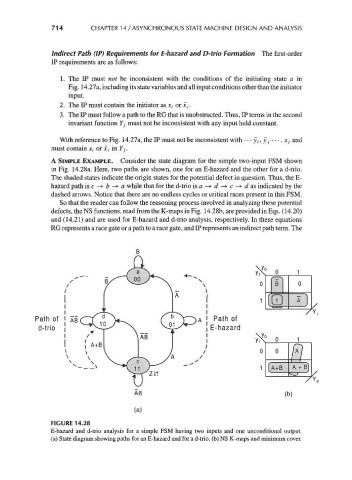
                    A SIMPLE EXAMPLE. Consider the state diagram for the simple two-input FSM shown
                    in Fig. 14.28a. Here, two paths are shown, one for an E-hazard and the other for a d-trio.
                    The shaded states indicate the origin states for the potential defect in question. Thus, the E-
                    hazard path is c —> b —> a while that for the d-trio isa-+d-+c-+das indicated by the
                    dashed arrows. Notice that there are no endless cycles or critical races present in this FSM.
                      So that the reader can follow the reasoning process involved in analyzing these potential
                    defects, the NS functions, read from the K-maps in Fig. 14.28b, are provided in Eqs. (14.20)
                    and (14.21) and are used for E-hazard and d-trio analysis, respectively. In these equations
                    RG represents a race gate or a path to a race gate, and IP represents an indirect path term. The


               Path of ABO in V^                   C n< IDA       Path of
                d-trio      ^^v/          X        V^*-^         E-hazard


                                                                                      (b)


                    FIGURE 14.28
                    E-hazard and d-trio analysis for a simple FSM having two inputs and one unconditional output,
                    (a) State diagram showing paths for an E-hazard and for a d-trio. (b) NS K-maps and minimum cover.

