


Page 747 - Engineering Digital Design
P. 747
14.10 DETECTION AND ELIMINATION OF TIMING DEFECTS                   713


                                                                       I — > I . in state a
                                                                       a   ab
                                                                                     ~  ab
                                                                   ab
                                                    st
                                                   1  Level
                                                  Race Gate             x x
                                                      if           'bc=- i r
                                                                       x. = Initiator input
                                                              Only a single change in the initiator x. is
                                                              allowed in f gb and f bcwith x and all other
                   y i = First invariant
                                                   Path to    inputs held constant.
                                                   nd
                    y. = Second invariant         2  Level
                                                  Race Gate          For E-hazard formation

                                                                      For D-trio formation
                                                                             S
                                                                          'ab   *cb
                                                                             (b)
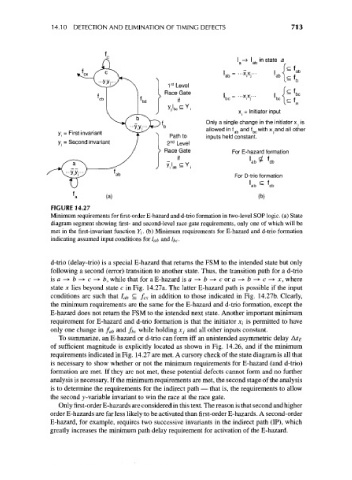
                 FIGURE 14.27
                 Minimum requirements for first-order E-hazard and d-trio formation in two-level SOP logic, (a) State
                 diagram segment showing first- and second-level race gate requirements, only one of which will be
                 met in the first-invariant function F,. (b) Minimum requirements for E-hazard and d-trio formation
                 indicating assumed input conditions for l ab and l bc-


                 d-trio (delay-trio) is a special E-hazard that returns the FSM to the intended state but only
                 following a second (error) transition to another state. Thus, the transition path for a d-trio
                 is a -» b ->• c -> b, while that for a E-hazard isa^b^-cora^b-*c^-x, where
                 state x lies beyond state c in Fig. 14.27a. The latter E-hazard path is possible if the input
                 conditions are such that I af, c f cx in addition to those indicated in Fig. 14.27b. Clearly,
                 the minimum requirements are the same for the E-hazard and d-trio formation, except the
                 E-hazard does not return the FSM to the intended next state. Another important minimum
                 requirement for E-hazard and d-trio formation is that the initiator jc, is permitted to have
                 only one change in f ab and f\, c while holding Xj and all other inputs constant.
                    To summarize, an E-hazard or d-trio can form iff an unintended asymmetric delay A/£
                 of sufficient magnitude is explicitly located as shown in Fig. 14.26, and if the minimum
                 requirements indicated in Fig. 14.27 are met. A cursory check of the state diagram is all that
                 is necessary to show whether or not the minimum requirements for E-hazard (and d-trio)
                 formation are met. If they are not met, these potential defects cannot form and no further
                 analysis is necessary. If the minimum requirements are met, the second stage of the analysis
                 is to determine the requirements for the indirect path — that is, the requirements to allow
                 the second j-variable invariant to win the race at the race gate.
                    Only first-order E-hazards are considered in this text. The reason is that second and higher
                 order E-hazards are far less likely to be activated than first-order E-hazards. A second-order
                 E-hazard, for example, requires two successive invariants in the indirect path (IP), which
                 greatly increases the minimum path delay requirement for activation of the E-hazard.

