


Page 749 - Engineering Digital Design
P. 749
14.10 DETECTION AND ELIMINATION OF TIMING DEFECTS                    715


                  subscripts E and D refer to the E-hazard and d-trio, respectively. Following the procedure
                 given in Subsection 14.10.3, a brief inspection of these NS functions indicates that they are
                 free of static hazards.


                                                                ^PathtoRG E
                                                                A
                                                                                     . o)
                                            *y,y 0      Y o = y  + M + ?,*         (14 2
                                                               0
                                        IP E
                                                                  ORing RG E

                                                                         -^v
                                                        Y 0 = y QA
                           Y,= y 0B + jjA +  yjy 0


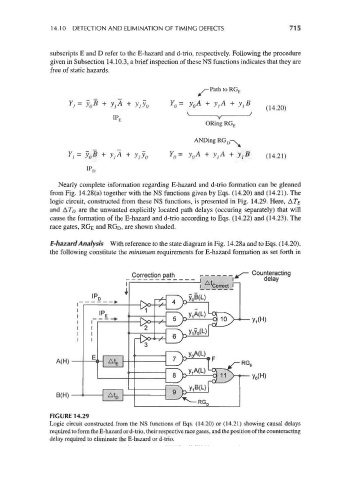
                    Nearly complete information regarding E-hazard and d-trio formation can be gleaned
                 from Fig. 14.28(a) together with the NS functions given by Eqs. (14.20) and (14.21). The
                 logic circuit, constructed from these NS functions, is presented in Fig. 14.29. Here, AT E
                 and A r D are the unwanted explicitly located path delays (occuring separately) that will
                 cause the formation of the E-hazard and d-trio according to Eqs. (14.22) and (14.23). The
                 race gates, RGe and RGo, are shown shaded.

                  E-hazard Analysis With reference to the state diagram in Fig. 14.28a and to Eqs. (14.20),
                 the following constitute the minimum requirements for E-hazard formation as set forth in


                                         Correction path     ^        ,^~   Cou S52, ctln 9
                                                             i A *    '        aeiay


                    A(H)


                    B(H)

                 FIGURE 14.29
                 Logic circuit constructed from the NS functions of Eqs. (14.20) or (14.21) showing causal delays
                 required to form the E-hazard or d-trio, their respective race gates, and the position of the counteracting
                 delay required to eliminate the E-hazard or d-trio.

