


Page 746 - Engineering Digital Design
P. 746
712        CHAPTER 14/ASYNCHRONOUS STATE MACHINE DESIGN AND ANALYSIS


                                                                         •| st  2 nd
                                                                        level  level
                                 1st    2nd                            9 ates  Sates
                                 level  level
                                gates  gates                        Direct path
                         Direct path                      X    -f—' At E j—>/T 1 }—i/RoV—•  y a
                                                                                       st
                                                        Initiator       VJ/^^ar^.y    1  Invariant
                   x —pJ At E j-x RG w-w   )       y a
                                                st
                 Initiator ^^''^^-^ ^-^       1  Invariant
                                                               s^t     \ 2|
                                                                 I
                                                                       ^^^^^^\
                                               nd
                                              2  Invariant      t i  Irtdireet ""^-4  T 3H  v b
                                                                                       nd
                                                                i  path        Kjy    2  Invariant
                                                                  _ <*, *~ *•
                                                                      l^Wnyrt,    —*
                                  (a)                                    (b)
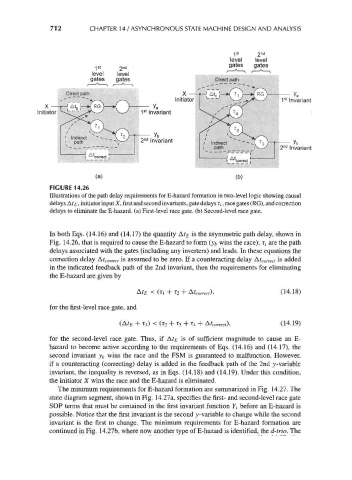
                    FIGURE 14.26
                    Illustrations of the path delay requirements for E-hazard formation in two-level logic showing causal
                    delays AtE, initiator input X, first and second invariants, gate delays r,, race gates (RG), and correction
                    delays to eliminate the E-hazard. (a) First-level race gate, (b) Second-level race gate.


                    In both Eqs. (14.16) and (14.17) the quantity A? £ is the asymmetric path delay, shown in
                    Fig. 14.26, that is required to cause the E-hazard to form (yb wins the race); T, are the path
                    delays associated with the gates (including any inverters) and leads. In these equations the
                    correction delay At correct is assumed to be zero. If a counteracting delay A.t correct is added
                    in the indicated feedback path of the 2nd invariant, then the requirements for eliminating
                    the E-hazard are given by

                                                   (TI + T 2 + &t correct),           (14.18)

                    for the first-level race gate, and
                                                   (r 2 + T 3 + r 4 + At correct\     (14.19)

                    for the second-level race gate. Thus, if At E is of sufficient magnitude to cause an E-
                    hazard to become active according to the requirements of Eqs. (14.16) and (14.17), the
                    second invariant yb wins the race and the FSM is guaranteed to malfunction. However,
                    if a counteracting (correcting) delay is added in the feedback path of the 2nd y-variable
                    invariant, the inequality is reversed, as in Eqs. (14.18) and (14.19). Under this condition,
                    the initiator X wins the race and the E-hazard is eliminated.
                      The minimum requirements for E-hazard formation are summarized in Fig. 14.27. The
                    state diagram segment, shown in Fig. 14.27a, specifies the first- and second-level race gate
                    SOP terms that must be contained in the first invariant function 7, before an E-hazard is
                    possible. Notice that the first invariant is the second y-variable to change while the second
                    invariant is the first to change. The minimum requirements for E-hazard formation are
                    continued in Fig. 14.27b, where now another type of E-hazard is identified, the d-trio. The

