


Page 741 - Engineering Digital Design
P. 741
14.10 DETECTION AND ELIMINATION OF TIMING DEFECTS                    707


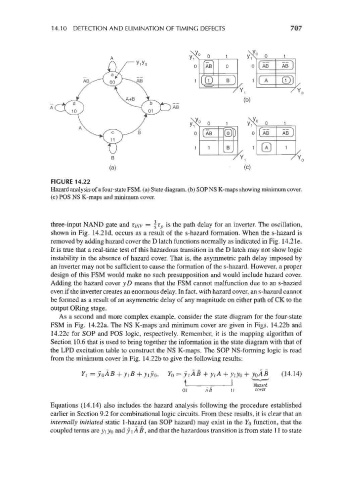
                  FIGURE 14.22
                  Hazard analysis of a four-state FSM. (a) State diagram, (b) SOP NS K-maps showing minimum cover.
                  (c) POS NS K-maps and minimum cover.


                  three-input NAND gate and T ]NV = f T P is the path delay for an inverter. The oscillation,
                  shown in Fig. 14.2 Id, occurs as a result of the s-hazard formation. When the s-hazard is
                  removed by adding hazard cover the D latch functions normally as indicated in Fig. 14.21e.
                  It is true that a real-time test of this hazardous transition in the D latch may not show logic
                  instability in the absence of hazard cover. That is, the asymmetric path delay imposed by
                  an inverter may not be sufficient to cause the formation of the s-hazard. However, a proper
                  design of this FSM would make no such presupposition and would include hazard cover.
                  Adding the hazard cover yD means that the FSM cannot malfunction due to an s-hazard
                  even if the inverter creates an enormous delay. In fact, with hazard cover, an s-hazard cannot
                  be formed as a result of an asymmetric delay of any magnitude on either path of CK to the
                  output ORing stage.
                    As a second and more complex example, consider the state diagram for the four-state
                  FSM in Fig. 14.22a. The NS K-maps and minimum cover are given in Figs. 14.22b and
                  14.22c for SOP and POS logic, respectively. Remember, it is the mapping algorithm of
                  Section 10.6 that is used to bring together the information in the state diagram with that of
                  the LPD excitation table to construct the NS K-maps. The SOP NS-forming logic is read
                  from the minimum cover in Fig. 14.22b to give the following results:
                                                   Y 0 = y\AB + y,A +  yiy 0 + y 0AB  (14.14)


                  Equations (14.14) also includes the hazard analysis following the procedure established
                  earlier in Section 9.2 for combinational logic circuits. From these results, it is clear that an
                  internally initiated static 1 -hazard (an SOP hazard) may exist in the YQ function, that the
                  coupled terms are y\ jo and y \ A B , and that the hazardous transition is from state 1 1 to state

