


Page 756 - Engineering Digital Design
P. 756
722         CHAPTER 14 / ASYNCHRONOUS STATE MACHINE DESIGN AND ANALYSIS


                       4. Collect the TT-partitions into partitions that include all states identifiers. These parti-
                         tions are called r (total) partitions. If this is properly done, all T-partitions will begin
                         with the state identifier for the initialization state on the left side of the partition.
                       5. Find a minimum set of T-partitions that "cover" all n -partitions. The number of T-
                         partitions is equal to the number of state variables for the FSM. There may be more
                         than one minimum set of T-partitions. If more than one minimum set of T-partitions
                         exist, the choice of any one of the minimum sets will lead to an optimum or near
                         optimum STT design — there is usually little difference in their use. A nonminimum
                         set of T-partitions will usually not yield an optimum STT design, but it can happen.
                       6. Select a valid state code assignment from a minimum set of T-partitions. Choose the
                         initialization state to be either a • • • 000 state or a • • • 111 state, not a mixture. See
                         Section 14.11 for rules governing the initialization of asynchronous FSMs. Note that
                         for FSMs lacking cross branching the partitioning method defaults to unit distance
                         coding of states as in Fig. 14.22.

                       At this point the array algebraic approach, discussed in Section 11.11, can be used to
                    obtain the NS and output functions for the STT state machine. The array algebraic approach
                    discussed here is actually an extension of the LPD model, since the lumped path delays in
                    the NS functions are implied.
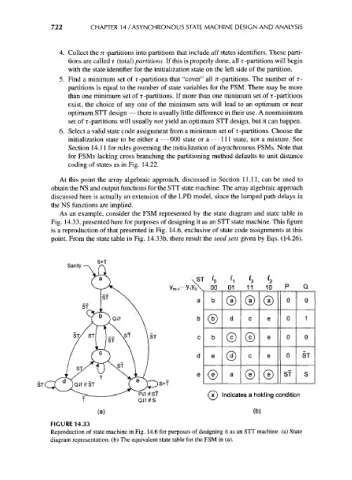
                       As an example, consider the FSM represented by the state diagram and state table in
                    Fig. 14.33, presented here for purposes of designing it as an STT state machine. This figure
                    is a reproduction of that presented in Fig. 14.6, exclusive of state code assignments at this
                    point. From the state table in Fig. 14.33b, there result the seed sets given by Eqs. (14.26).


                                 S+T
                         Sanity
                                                              ST  I 0   IT   I 3  I 2
                                                                  oo   01   11    10   P    Q
                                                                                        0    0


                                                 ST

                                                                                            ST


                                                                                       ST
                                                                 V_/        X '  ^_S
                                                   S+T
                                             PATifSf             (^) indicates a holding condition
                                             Q1T if S            ^-^
                                  (a)                                         (b)
                    FIGURE 14.33
                    Reproduction of state machine in Fig. 14.6 for purposes of designing it as an STT machine, (a) State
                    diagram representation, (b) The equivalent state table for the FSM in (a).

