


Page 758 - Engineering Digital Design
P. 758
724         CHAPTER 14/ASYNCHRONOUS STATE MACHINE DESIGN AND ANALYSIS


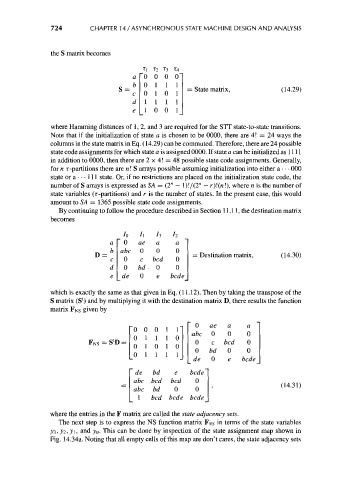
                    the S matrix becomes

                                               TI  ^2  ^3  T 4
                                            a  0 0 0 0"
                                            b  0 1 1 1
                                        S =                = State matrix,            (14.29)
                                            c  0 1 0 1
                                            d  1 1 1 1
                                            e  1 0 0 1

                    where Hamming distances of 1, 2, and 3 are required for the STT state-to-state transitions.
                    Note that if the initialization of state a is chosen to be 0000, there are 4! = 24 ways the
                    columns in the state matrix in Eq. (14.29) can be commuted. Therefore, there are 24 possible
                    state code assignments for which state a is assigned 0000. If state a can be initialized as 1111
                    in addition to 0000, then there are 2 x 4! = 48 possible state code assignments. Generally,
                    for n T-partitions there are n! S arrays possible assuming initialization into either a • • • 000
                    state or a • • • 111 state. Or, if no restrictions are placed on the initialization state code, the
                                                      n
                    number of S arrays is expressed as SA = (2  — l)!/(2" — r}\(n!), where n is the number of
                    state variables (T-partitions) and r is the number of states. In the present case, this would
                    amount to SA = 1365 possible state code assignments.
                       By continuing to follow the procedure described in Section 11.11, the destination matrix
                    becomes

                                         /O   /I  /3   /2
                                         0   ae   a     a
                                        abc 0     0     0
                                                             = Destination matrix,    (14.30)
                                         0    c   bed   0
                                     d   0   W • 0      0
                                     e   de   0    e   bcde

                    which is exactly the same as that given in Eq. (11.12). Then by taking the transpose of the
                             1
                    S matrix (S ) and by multiplying it with the destination matrix D, there results the function
                    matrix FNS given by

                                           "0 0 0 i r       " 0   ae   a    a
                                            0 1 1 1 0        abc  0    0    0
                               F NS =S'D =                    0   c   bed   0
                                            0 1 0    1 0      0        0    0
                                            0 1 1 1 1             bd
                                                             de   0    e   bcde
                                            de    bd    e   bcde
                                            abc bed    bed    0
                                                                                      (14.31)
                                            abc bd      0     0
                                             1   bed bcde bcde

                    where the entries in the F matrix are called the state adjacency sets.
                       The next step is to express the NS function matrix FJVS in terms of the state variables
                    J3, j2, vj, and y 0. This can be done by inspection of the state assignment map shown in
                    Fig. 14.34a. Noting that all empty cells of this map are don't cares, the state adjacency sets

