


Page 348 - Engineering Plastics Handbook
P. 348
Polyarylethersulfones (PAES)  305

        environmental stress cracking, and the ability to withstand various
        environments is called environmental stress crack resistance (ESCR).
        The amount of susceptibility that a plastic exhibits to an environment
        depends on three important factors: temperature, amount of applied
        stress, and the concentration of the chemically aggressive medium.
        Because polysulfones are amorphous, they are vulnerable to some
        organic environments. This is due to greater ease of diffusion of aggres-
        sive solvents into the polymer, which in turn disrupts the electrostatic
        and dipole forces between the chain segments and facilitates chain dis-
        entanglement under applied stress. The potency of a stress cracking
        agent is related to the match between the solubility parameter of the
        solvent and that of the polymer. For example, PSF, which has a solubility
                                 3 1/2
        parameter of δ= 21.8 (J/cm ) , resists aliphatic hydrocarbons of lower
        δ and most alcohols of higher δ, but readily undergoes stress cracking
        by ketones that have δ values close to that of the polymer. For polysul-
        fones, the most problematic solvents are aromatics, chlorinated hydro-
        carbons, ketones, and esters. The resistance of the commercially
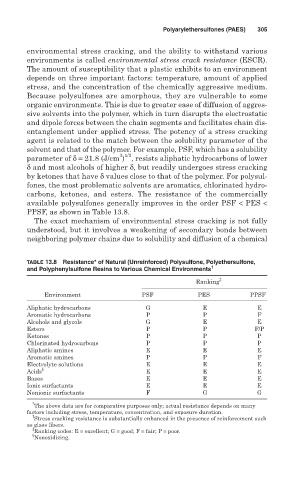
        available polysulfones generally improves in the order PSF < PES <
        PPSF, as shown in Table 13.8.
          The exact mechanism of environmental stress cracking is not fully
        understood, but it involves a weakening of secondary bonds between
        neighboring polymer chains due to solubility and diffusion of a chemical


        TABLE 13.8  Resistance* of Natural (Unreinforced) Polysulfone, Polyethersulfone,
        and Polyphenylsulfone Resins to Various Chemical Environments †
                                                      Ranking ‡
             Environment               PSF            PES           PPSF
        Aliphatic hydrocarbons          G               E             E
        Aromatic hydrocarbons           P               P             F
        Alcohols and glycols            G               E             E
        Esters                          P               P             F/P
        Ketones                         P               P             P
        Chlorinated hydrocarbons        P               P             P
        Aliphatic amines                E               E             E
        Aromatic amines                 P               P             F
        Electrolyte solutions           E               E             E
        Acids §                         E               E             E
        Bases                           E               E             E
        Ionic surfactants               E               E             E
        Nonionic surfactants            F               G             G
          *
          The above data are for comparative purposes only; actual resistance depends on many
        factors including stress, temperature, concentration, and exposure duration.
          †
          Stress cracking resistance is substantially enhanced in the presence of reinforcement such
        as glass fibers.
          ‡
          Ranking codes: E = excellent; G = good; F = fair; P = poor.
          §
          Nonoxidizing.

