


Page 347 - Engineering Plastics Handbook
P. 347
304   Engineering Plastics

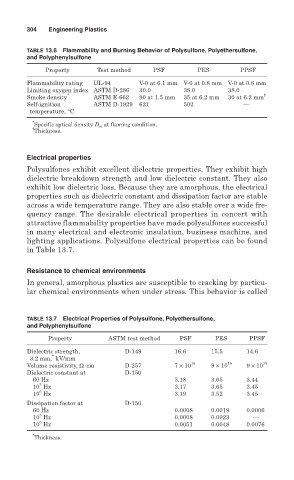
        TABLE 13.6  Flammability and Burning Behavior of Polysulfone, Polyethersulfone,
        and Polyphenylsulfone
             Property      Test method    PSF         PES         PPSF

        Flammability rating  UL-94     V-0 at 6.1 mm  V-0 at 0.8 mm  V-0 at 0.8 mm
        Limiting oxygen index ASTM D-286  30.0    38.0        38.0
        Smoke density *   ASTM E-662   90 at 1.5 mm  35 at 6.2 mm  30 at 6.2 mm †
        Self-ignition     ASTM D-1929  621        502              —
         temperature, °C
          *
          Specific optical density D m at flaming condition.
          †
          Thickness.

        Electrical properties
        Polysulfones exhibit excellent dielectric properties. They exhibit high
        dielectric breakdown strength and low dielectric constant. They also
        exhibit low dielectric loss. Because they are amorphous, the electrical
        properties such as dielectric constant and dissipation factor are stable
        across a wide temperature range. They are also stable over a wide fre-
        quency range. The desirable electrical properties in concert with
        attractive flammability properties have made polysulfones successful
        in many electrical and electronic insulation, business machine, and
        lighting applications. Polysulfone electrical properties can be found
        in Table 13.7.


        Resistance to chemical environments
        In general, amorphous plastics are susceptible to cracking by particu-
        lar chemical environments when under stress. This behavior is called


        TABLE 13.7  Electrical Properties of Polysulfone, Polyethersulfone,
        and Polyphenylsulfone
              Property        ASTM test method   PSF       PES      PPSF

        Dielectric strength,       D-149        16.6      15.5     14.6
               *
         3.2 mm, kV/mm
        Volume resistivity, Ω⋅cm   D-257        7 × 10 16  9 × 10 16  9 × 10 15
        Dielectric constant at     D-150
          60 Hz                                 3.18      3.65     3.44
            3
          10 Hz                                 3.17      3.65     3.45
            6
          10 Hz                                 3.19      3.52     3.45
        Dissipation factor at      D-150
          60 Hz                                 0.0008    0.0019   0.0006
            3
          10 Hz                                 0.0008    0.0023     —
            6
          10 Hz                                 0.0051    0.0048   0.0076
          *
          Thickness.

