


Page 342 - Engineering Plastics Handbook
P. 342
300   Engineering Plastics

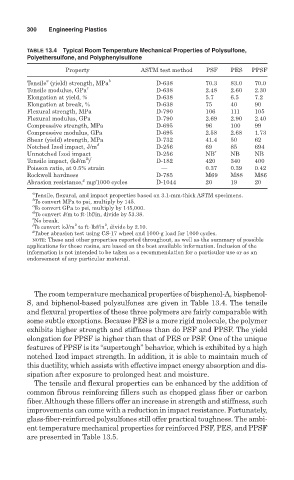
        TABLE 13.4  Typical Room Temperature Mechanical Properties of Polysulfone,
        Polyethersulfone, and Polyphenylsulfone
                   Property            ASTM test method  PSF   PES   PPSF
              a               b
        Tensile (yield) strength, MPa      D-638        70.3   83.0   70.0
        Tensile modulus, GPa c             D-638        2.48   2.60   2.30
        Elongation at yield, %             D-638        5.7    6.5    7.2
        Elongation at break, %             D-638        75     40     90
        Flexural strength, MPa             D-790        106    111    105
        Flexural modulus, GPa              D-790        2.69   2.90   2.40
        Compressive strength, MPa          D-695        96     100    99
        Compressive modulus, GPa           D-695        2.58   2.68   1.73
        Shear (yield) strength, MPa        D-732        41.4   50     62
        Notched Izod impact, J/m d         D-256        69     85     694
                                                           e
        Unnotched Izod impact              D-256        NB     NB     NB
                        2 f
        Tensile impact, (kJ/m )            D-182        420    340    400
        Poisson ratio, at 0.5% strain       —           0.37   0.39   0.42
        Rockwell hardness                  D-785        M69    M88    M86
                       g
        Abrasion resistance, mg/1000 cycles  D-1044     20     19     20
          a
          Tensile, flexural, and impact properties based on 3.1-mm-thick ASTM specimens.
          b
          To convert MPa to psi, multiply by 145.
          c
          To convert GPa to psi, multiply by 145,000.
          d
          To convert J/m to ft⋅lbf/in, divide by 53.38.
          e
          No break.
          f          2       2
          To convert kJ/m to ft⋅lbf/in , divide by 2.10.
          g
          Taber abrasion test using CS-17 wheel and 1000-g load for 1000 cycles.
          NOTE: These and other properties reported throughout, as well as the summary of possible
        applications for these resins, are based on the best available information. Inclusion of the
        information is not intended to be taken as a recommendation for a particular use or as an
        endorsement of any particular material.
          The room temperature mechanical properties of bisphenol-A, bisphenol-
        S, and biphenol-based polysulfones are given in Table 13.4. The tensile
        and flexural properties of these three polymers are fairly comparable with
        some subtle exceptions. Because PES is a more rigid molecule, the polymer
        exhibits higher strength and stiffness than do PSF and PPSF. The yield
        elongation for PPSF is higher than that of PES or PSF. One of the unique
        features of PPSF is its “supertough” behavior, which is exhibited by a high
        notched Izod impact strength. In addition, it is able to maintain much of
        this ductility, which assists with effective impact energy absorption and dis-
        sipation after exposure to prolonged heat and moisture.
          The tensile and flexural properties can be enhanced by the addition of
        common fibrous reinforcing fillers such as chopped glass fiber or carbon
        fiber. Although these fillers offer an increase in strength and stiffness, such
        improvements can come with a reduction in impact resistance. Fortunately,
        glass-fiber-reinforced polysulfones still offer practical toughness. The ambi-
        ent temperature mechanical properties for reinforced PSF, PES, and PPSF
        are presented in Table 13.5.

