


Page 339 - Engineering Plastics Handbook
P. 339
Polyarylethersulfones (PAES)  297

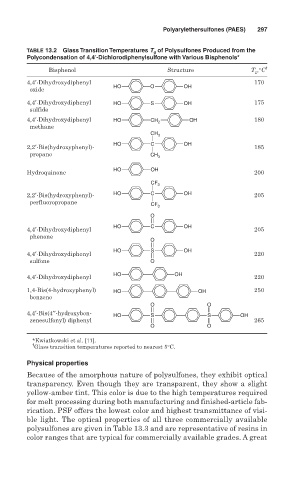
        TABLE 13.2  Glass Transition Temperatures T g of Polysulfones Produced from the
        Polycondensation of 4,4′-Dichlorodiphenylsulfone with Various Bisphenols*
              Bisphenol                       Structure              T g ,°C †
        4,4′-Dihydroxydiphenyl                                        170
                                HO        O        OH
         oxide
        4,4′-Dihydroxydiphenyl  HO        S        OH                 175
         sulfide
        4,4′-Dihydroxydiphenyl  HO        CH 2      OH                180
         methane
                                          CH
                                            3
                                HO        C        OH
        2,2′-Bis(hydroxyphenyl)-                                      185
         propane                          CH
                                            3
                                HO        OH
        Hydroquinone                                                  200
                                          CF 3
        2,2′-Bis(hydroxyphenyl)-  HO      C        OH                 205
         perfluoropropane                 CF 3
                                          O
                                HO        C        OH
        4,4′-Dihydroxydiphenyl                                        205
         phenone
                                          O
                                HO        S        OH
        4,4′-Dihydroxydiphenyl                                        220
         sulfone                          O
                                HO              OH
        4,4′-Dihydroxydiphenyl                                        220
        1,4-Bis(4-hydroxyphenyl)  HO                  OH              250
         benzene
                                          O              O
        4,4′-Bis(4′′-hydroxyben-
                                HO        S              S        OH
         zenesulfonyl) diphenyl                                       265
                                          O              O
          *Kwiatkowski et al. [11].
          †
          Glass transition temperatures reported to nearest 5°C.
        Physical properties
        Because of the amorphous nature of polysulfones, they exhibit optical
        transparency. Even though they are transparent, they show a slight
        yellow-amber tint. This color is due to the high temperatures required
        for melt processing during both manufacturing and finished-article fab-
        rication. PSF offers the lowest color and highest transmittance of visi-
        ble light. The optical properties of all three commercially available
        polysulfones are given in Table 13.3 and are representative of resins in
        color ranges that are typical for commercially available grades. A great

