


Page 340 - Engineering Plastics Handbook
P. 340
298   Engineering Plastics

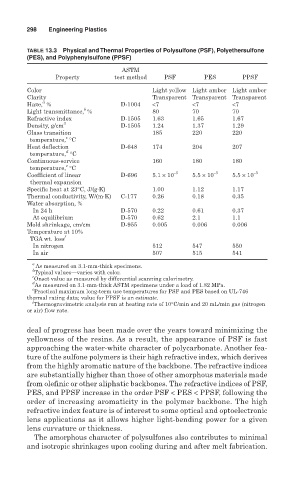
        TABLE 13.3  Physical and Thermal Properties of Polysulfone (PSF), Polyethersulfone
        (PES), and Polyphenylsulfone (PPSF)
                                  ASTM
                Property        test method  PSF        PES       PPSF
        Color                             Light yellow Light amber Light amber
        Clarity                           Transparent Transparent Transparent
             a
        Haze, %                   D-1004  <7         <7         <7
                        b
        Light transmittance, %            80         70         70
        Refractive index          D-1505  1.63       1.65       1.67
                  3
        Density, g/cm             D-1505  1.24       1.37       1.29
        Glass transition                  185        220        220
                   c
         temperature, °C
        Heat deflection           D-648   174        204        207
                   d
         temperature, °C
        Continuous-service                160        180        180
                   e
         temperature, °C
        Coefficient of linear     D-696   5.1 × 10 −5  5.5 × 10 −5  5.5 × 10 −5
         thermal expansion
        Specific heat at 23°C, J/(g⋅K)    1.00       1.12       1.17
        Thermal conductivity, W/(m⋅K)  C-177  0.26   0.18       0.35
        Water absorption, %
          In 24 h                 D-570   0.22       0.61       0.37
          At equilibrium          D-570   0.62       2.1        1.1
        Mold shrinkage, cm/cm     D-955   0.005      0.006      0.006
        Temperature at 10%
                  f
         TGA wt. loss
          In nitrogen                     512        547        550
          In air                          507        515        541
          a
           As measured on 3.1-mm-thick specimens.
          b
          Typical values—varies with color.
          c
          Onset value as measured by differential scanning calorimetry.
          d
          As measured on 3.1-mm-thick ASTM specimens under a load of 1.82 MPa.
          e
          Practical maximum long-term use temperatures for PSF and PES based on UL-746
        thermal rating data; value for PPSF is an estimate.
          f
          Thermogravimetric analysis run at heating rate of 10°C/min and 20 mL/min gas (nitrogen
        or air) flow rate.
        deal of progress has been made over the years toward minimizing the
        yellowness of the resins. As a result, the appearance of PSF is fast
        approaching the water-white character of polycarbonate. Another fea-
        ture of the sulfone polymers is their high refractive index, which derives
        from the highly aromatic nature of the backbone. The refractive indices
        are substantially higher than those of other amorphous materials made
        from olefinic or other aliphatic backbones. The refractive indices of PSF,
        PES, and PPSF increase in the order PSF < PES < PPSF, following the
        order of increasing aromaticity in the polymer backbone. The high
        refractive index feature is of interest to some optical and optoelectronic
        lens applications as it allows higher light-bending power for a given
        lens curvature or thickness.
          The amorphous character of polysulfones also contributes to minimal
        and isotropic shrinkages upon cooling during and after melt fabrication.

