


Page 345 - Engineering Plastics Handbook
P. 345
302   Engineering Plastics

          The data mentioned previously in Table 13.4 give short-term mechan-
        ical properties under very simple loading conditions. These values are
        typical of commercially available PSF, PES, and PPSF of practical molec-
        ular weight. When one is considering a polymer for a particular end-use
        application, it is very important to also consider other service life fac-
        tors such as creep and fatigue properties as well as temperature and
        other environmental factors.


        Thermal properties
        As mentioned previously, polysulfones offer excellent thermal stability
        and resistance to oxidation during manufacture and melt processing as
        well as in the end use. Polysulfones can be melt-processed at temperatures
        up to 400°C. Their excellent thermal stability is evidenced by their behav-
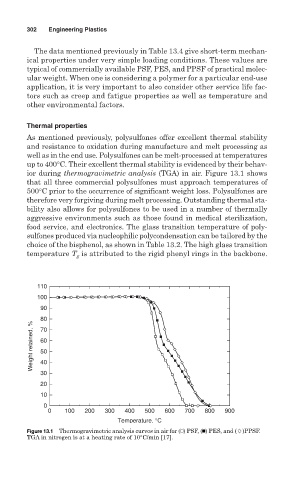
        ior during thermogravimetric analysis (TGA) in air. Figure 13.1 shows
        that all three commercial polysulfones must approach temperatures of
        500°C prior to the occurrence of significant weight loss. Polysulfones are
        therefore very forgiving during melt processing. Outstanding thermal sta-
        bility also allows for polysulfones to be used in a number of thermally
        aggressive environments such as those found in medical sterilization,
        food service, and electronics. The glass transition temperature of poly-
        sulfones produced via nucleophilic polycondensation can be tailored by the
        choice of the bisphenol, as shown in Table 13.2. The high glass transition
        temperature T is attributed to the rigid phenyl rings in the backbone.
                      g


           110
           100
            90
            80
          Weight retained, %  60
            70


            50
            40
            30
            20
            10
             0
              0   100   200  300   400  500  600   700  800   900
                                 Temperature, °C
        Figure 13.1 Thermogravimetric analysis curves in air for (▫) PSF, ( ) PES, and ( )PPSF.
        TGA in nitrogen is at a heating rate of 10°C/min [17].

