


Page 346 - Engineering Plastics Handbook
P. 346
Polyarylethersulfones (PAES)  303

        It is also attributed to the sulfone group. The strong dipole interactions
        and restricted rotation of the aromatic units relative to the other groups
        contribute to the rigidity of the molecule. Other connecting groups can
        result in either an increase or a decrease in the rigidity of the polymer chain
        and  T , depending on the polarity and the conformational freedom
              g
        imparted by those groups.
          In addition to offering resistance to degradation at high temperatures,
        polysulfones maintain their mechanical properties at high temperatures
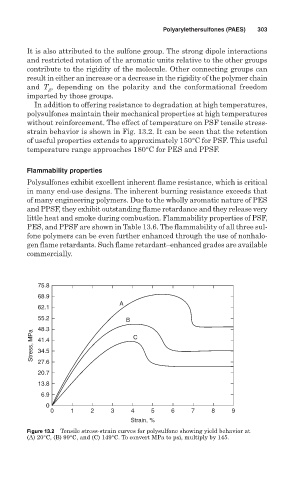
        without reinforcement. The effect of temperature on PSF tensile stress-
        strain behavior is shown in Fig. 13.2. It can be seen that the retention
        of useful properties extends to approximately 150°C for PSF. This useful
        temperature range approaches 180°C for PES and PPSF.

        Flammability properties
        Polysulfones exhibit excellent inherent flame resistance, which is critical
        in many end-use designs. The inherent burning resistance exceeds that
        of many engineering polymers. Due to the wholly aromatic nature of PES
        and PPSF, they exhibit outstanding flame retardance and they release very
        little heat and smoke during combustion. Flammability properties of PSF,
        PES, and PPSF are shown in Table 13.6. The flammability of all three sul-
        fone polymers can be even further enhanced through the use of nonhalo-
        gen flame retardants. Such flame retardant–enhanced grades are available
        commercially.


           75.8
           68.9
                                 A
           62.1
           55.2                    B
           48.3
          Stress, MPa  41.4          C
           34.5
           27.6
           20.7
           13.8
            6.9
             0
               0    1    2     3    4     5    6     7    8    9
                                    Strain, %
        Figure 13.2 Tensile stress-strain curves for polysulfone showing yield behavior at
        (A) 20°C, (B) 99°C, and (C) 149°C. To convert MPa to psi, multiply by 145.

